Guilt-Free Gratitude: What the Science Actually Says
Thomas Ray, PhD
Associate Executive Director
Poe Center for Health Education
When people ask me how I’m doing, I usually say, “Livin’ the dream.” While some folks I see daily may groan in response (they hear it all the time), the truth is that that phrase sums up my approach to life in general.
When some probe a bit more and ask what I mean, I explain that I have so much in my life to be thankful for that it keeps me focused on the good things. I don’t list those things out every day – rather, the sense of gratitude just underlies the ins and outs of daily life.
Researchers have a name for this: trait gratitude. It is a lasting tendency to notice the good things in your life and to recognize that many of those things come from outside yourself. Trait gratitude is different from the brief thankful feeling you get when someone holds a door for you as you’re struggling with full arms and no extra hands. Trait gratitude is the baseline that makes acknowledging those moments a more frequent practice.
Gratitude journals, apps and “three good things” challenges are everywhere, and many promise better health. So what does the research actually show? I reviewed studies published over the last several years, including reviews that pooled results from tens of thousands of people. I also drew from my own doctoral research on happiness, where gratitude was a major theme. Here are five key takeaways:
1. Gratitude gives your mood a small, reliable lift
The largest review about gratitude to date combined 145 studies with almost 25,000 people in 28 countries. People who practiced gratitude reported more positive emotions, greater life satisfaction, and fewer symptoms of depression than people who did not. The biggest gain was in positive emotions.
Be advised that the effect in these studies is modest: gratitude is more of a steady nudge in a good direction, not necessarily a light switch that will result in a dramatic change overnight. For people living with depression or anxiety, gratitude exercises will lower symptoms only a little. They work best alongside counseling and medical care, not in place of them.
2. Grateful people tend to sleep better and live longer
Trait gratitude shows some of the strongest links to physical health.
-
- Sleep: Sleep is the best-supported physical benefit. In a review of gratitude studies on physical health, sleep quality improved in 5 of 8 trials.
- Heart health: In a study of nearly 5,000 adults tracked through daily life, more grateful people had lower everyday heart rate and blood pressure.
- Longevity: In a study of more than 49,000 older women, those with the highest gratitude scores had a 9% lower risk of death during the study, and a 15% lower risk of death from heart disease than those with the lowest scores. This held after accounting for health, lifestyle, social ties and mental health.
These are associations, so they do not prove that gratitude causes longer life. However, they do indicate a pathway toward those ends: gratitude eases stress, strengthens relationships, and supports healthier habits, and each of those protects the body over time.
3. Gratitude doesn’t have to come with guilt
In my dissertation at NC State, I studied how participants in a Wake County goal-setting program viewed happiness. One pattern stood out. Across every viewpoint that emerged, participants agreed with the statement “I am generally a thankful person,” and “I often remember times when I was grateful for something someone did for me.” But most of them did not rank “Expressing gratitude helps me feel happy” as important to their happiness. They felt grateful and remembered being grateful. Saying thank you was not what made
them happy.
It was a small study, but the larger research points the same way. In the 2025 review of 25,000 people, recalling a specific grateful moment improved well-being more than expressing thanks to others. The same review noted that for some people, and in some cultures, thanking someone brings mixed feelings such as a sense of indebtedness or guilt.
The takeaway: gratitude does not have to be performed, and it does not always have to be about people. If thanking someone feels like you now owe them in some way, choose a different focus. You can be grateful for a quiet morning, a good meal, a walk outside, or a moment of reflection.
4. Try this: write a thank-you letter, and don’t feel obligated to send it
Writing a letter of thanks to someone who made a difference in your life is one of the most studied gratitude practices. A review of 25 trials with more than 6,700 people found it improved well-being, and the benefit was the same whether or not the letter was ever delivered. The act of gratitude benefits the writer regardless.
So write it for yourself. Name a specific person, describe what they did, and explain how it affected you. Send it if you want to. Keep it if you don’t.
5. Try this: treat gratitude like a goal you chose, not a daily streak
My dissertation also looked at goals and lasting happiness. The research is consistent: happiness gains hold up when goals are self-chosen, flexible, and meaningful to you. Goals imposed by someone else, or held too rigidly, tend not to stick. Gratitude practice can work the same way. Studies that asked people to express gratitude several times a day found little or no benefit. Other research found weekly practice worked better than daily. Very short efforts, a handful of entries and then stopping, showed no effect.
Instead, aim for a steady rhythm you choose: once or twice a week for a month. Recalling one specific good moment in detail tends to work better than rushing through a list. Mixing practices, such as a weekly journal entry plus an occasional letter, produced the largest gains. Over time, the goal is less about the exercise and more about the habit of noticing, the kind of gratitude that persists even on days you don’t write
anything down.
Getting started this week:
-
- Pick one evening this week. Before bed, write down one specific good moment from the past few days and why it mattered.
- Next week, write a short thank-you letter to someone. Decide afterward whether to send it.
- Keep going about once a week for a month. Notice how you sleep and how you feel.
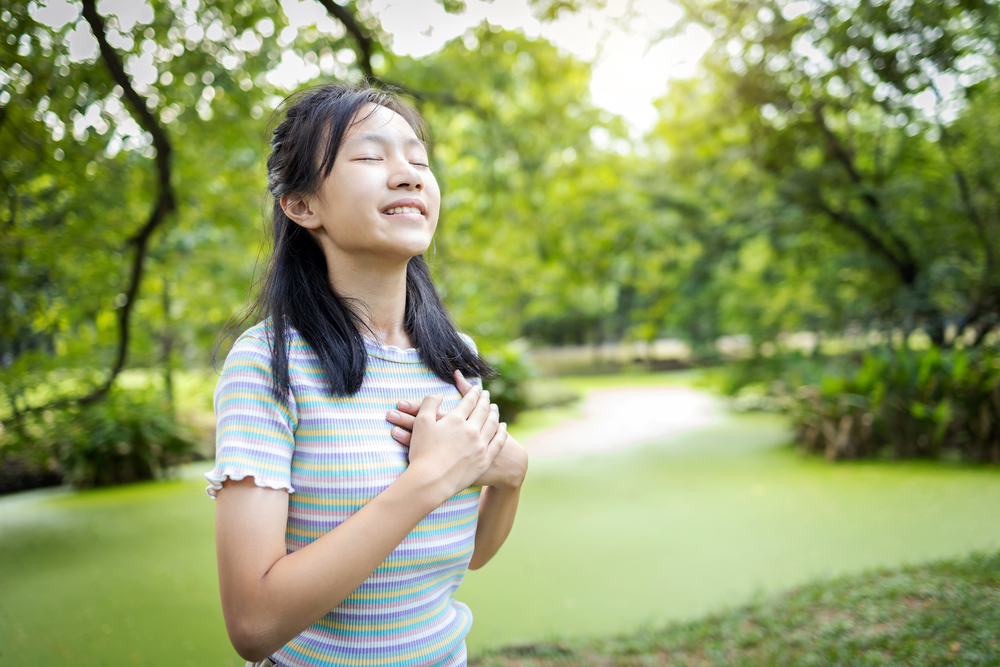
There’s a wise quote that I come back to often: “In everything, give thanks.” Not for everything, but in everything. Hard days still hold something worth noticing. That is the challenge I offer. Don’t aim for a perfect journal or a daily streak. Aim for a habit of noticing the good, in whatever form fits you, until “living the dream” becomes more than a figure of speech. I invite you to join me in practicing gratitude – an invitation,
not an obligation.
For more on practicing gratitude, I encourage you to attend a Poe Center program: Community Resiliency Model®. Several of the techniques taught in this program can be applied to everyday life and, when practiced regularly, can influence your trait gratitude.
References
Boggiss, A. L., Consedine, N. S., Brenton-Peters, J. M., Hofman, P. L., & Serlachius, A. S. (2020). A systematic review of gratitude interventions: Effects on physical health and health behaviors. Journal of Psychosomatic Research, 135, Article 110165. A systematic review of gratitude interventions: Effects on physical health and health behaviors.
Chen, Y., Okereke, O. I., Kim, E. S., Tiemeier, H., Kubzansky, L. D., & VanderWeele, T. J. (2024). Gratitude and mortality among older US female nurses. JAMA Psychiatry, 81(10), 1030–1038. Gratitude and mortality among older US female nurses.
Choi, H., Cha, Y., McCullough, M. E., Coles, N. A., & Oishi, S. (2025). A meta-analysis of the effectiveness of gratitude interventions on well-being across cultures. Proceedings of the National Academy of Sciences, 122(28), Article e2425193122. A meta-analysis of the effectiveness of gratitude interventions on well-being across cultures.
Cregg, D. R., & Cheavens, J. S. (2021). Gratitude interventions: Effective self-help? A meta-analysis of the impact on symptoms of depression and anxiety. Journal of Happiness Studies, 22(1), 413–445. Gratitude interventions: Effective self-help? A meta-analysis of the impact on symptoms of depression and anxiety.
Kirca, A., Malouff, J. M., & Meynadier, J. (2023). The effect of expressed gratitude interventions on psychological wellbeing: A meta-analysis of randomised controlled studies. International Journal of Applied Positive Psychology, 8, 63–86. The effect of expressed gratitude interventions on psychological wellbeing: A meta-analysis of randomised controlled studies.
Komase, Y., Watanabe, K., Hori, D., Nozawa, K., Hidaka, Y., Iida, M., Imamura, K., & Kawakami, N. (2021). Effects of gratitude intervention on mental health and well-being among workers: A systematic review. Journal of Occupational Health, 63(1), Article e12290. Effects of gratitude intervention on mental health and well-being among workers: A systematic review.
Newman, D. B., Gordon, A. M., & Mendes, W. B. (2021). Comparing daily physiological and psychological benefits of gratitude and optimism using a digital platform. Emotion, 21(7), 1357–1365. Comparing daily physiological and psychological benefits of gratitude and optimism using a digital platform.
Ray, T. B. (2018). Exploring happiness of participants in Middle Class Express: A Q methodological study [Doctoral dissertation, North Carolina State University]. NC State Repository. Exploring happiness of participants in Middle Class Express: A Q methodological study.
Featured Program:
Building skills to manage your nervous and threat-response systems can help you navigate stress and increase resilience. The Community Resiliency Model® is evidence-based and trains adults and youth to support themselves and others within their community. Through hands-on activities, discussions, and practice, participants learn practical tools to help balance their nervous system.
The goal of this program is to help create “trauma-informed” and “resilience-focused” communities that share a common understanding of the impact trauma and chronic stress have on the nervous system and how resilience can be restored or enhanced through this approach.
Schedule this program for: Adults, Educators/Professionals
Program Length: 60 minutes to 2 day training
The Poe Center regularly offers mental wellness workshops for adults and youth.
Find a list of upcoming events on our Events page.