Holiday Message from the US Department of Health & Human Services Office of Adolescent Health
Holiday Message from the United States Department of Health & Human Services Office of Adolescent Health
The holidays are in full swing but, as a nation, our hearts are heavy as we grieve the innocent lives lost in Newtown, Connecticut. This tragedy has prompted many of us to pause and consider ways to strengthen our connections with adolescents in our lives, both during the holidays and beyond.
May the holiday season provide you with opportunities to spend quality time with the adolescents in your lives. That's one thing we can all do to help them build the resiliency they will need for good health their whole lives through.
Did You Know?
Strong bonds with parents and other caring adults help adolescents to handle stress and improve overall mental health.1 For help talking with teens about the recent tragedy, check out this new resource from the Substance Abuse and Mental Health Administration (SAMHSA), Tips for Talking With and Helping Children and Youth Cope After a Disaster or Traumatic Event.
Be Proud
86% of teens report that their parents always or sometimes let them know they were proud of something they had done.2
Text and Connect
Parents and other caring adults can text teens to let them know that they’re proud of them. Check out seven sample text messages on OAH’s Talking with Teens site!
Getting Mental Health Help:
- If adolescents (or anyone in a family) need mental health help, SAMHSA's Mental Health Services Locator is an online, map-based program that can help visitors find near-by facilities.
- SAMHSA also operates a Disaster Distress Helpline. You can reach trained counselors who can provide crisis counseling, info on how to recognize distress and its effects, tips for healthy coping, and/or referrals to local crisis call centers. Open 24 hours, every day of the year, call 1-800-985-5990 or text "TalkWithUs" to 66746.
- YouMatter is a National Suicide Prevention Lifeline site for youth, complete with a blog where visitors can share problems and get support. Reach the National Suicide Prevention Lifeline at 1-800-273-8255.
- 2-1-1 is an easy to remember telephone number that connects about 90% of the U.S. population to information about critical health and human services available in their community such as mental health services and support for youth and families. It is administered through a national partnership between United Way Worldwide and the Alliance of Information and Referral Services (AIRS).
Tools for Positive Parenting:
- These positive tips for parents of teens from the Centers for Disease Control and Prevention (CDC) that includes ways to address teens’ emotional and social changes.
- New from the National Institute on Drug Abuse (NIDA), Family Checkup: Positive Parenting Prevents Drug Abuse is a five-question tool that teaches research-based parenting skills to help parents keep their adolescents drug-free.
- The CDC recently released resources for parents, school administrators, and teachers on how they can improve the engagement of parents in school health.
1 Masten, A. S., & Coatsworth, J. D. (1998). The development of competence in favorable and unfavorable environments: Lessons from research on successful children. American Psychologist, 53(2), 205-220. Available here.
2 Substance Abuse and Mental Health Services Administration. (2012). Results from the 2011 National Survey on Drug Use and Health: Summary of National Findings, NSDUH Series H-44, HHS Publication No. (SMA) 12-4713. Available here.

Help Protect the Work of the Poe Center & ALL Nonprofits
Help Protect the Work of the Poe Center & ALL Nonprofits
News media are reporting that the President Barack Obama and House Speaker John Boehner are seriously considering imposing new limits on the charitable giving incentive as part of a package to avert the "fiscal cliff." Unless they hear a huge groundswell of opposition immediately, the ability of charitable nonprofits - everything from churches and synagogues to local food banks, cultural groups, Girl Scouts, and United Ways - to raise the funds they need to serve others may be sharply curbed for many years to come. The Center on Philanthropy at Indiana University estimates that this proposal would take away $2.43 billion a year from nonprofits.
THE MOST IMPORTANT THINGS YOU CAN DO:
Call the White House (202-456-1111) and the Speaker (202-225-0600) NOW and give the operator this message:
- The 28% limit on charitable deductions hurts front-line charities serving people in need. Don't hurt the helpers. Don't limit charitable deductions!
- Give your name, city, and state, and tell what the charitable deduction means to the work you do or the services you rely on.
Also send Tweets to @WhiteHouse and @SpeakerBoehner telling them not to limit charitable deductions. Consider this sample Tweet:
@WhiteHouse @SpeakerBoehner - Capping charitable deductions hurts communities. Say no to 28% limit! #protectgiving
Please help the Poe Center and ALL Nonprofits so we can continue to serve our communities!
Give the Gift of Health Education
Give the Gift of Health Education this Holiday Season & Seymour Poe Will Mail Your Gift for You!
For every $15 tax-deductible donation, a child in North Carolina will be able to attend a health education and prevention program at the Poe Center!
 Each donation made will add a "Seymour Poe" to our holiday tree.

An acknowledgement card, like the one to the right, will be mailed to the individual or family you chose to honor or memorialize.
The Poe Center will also include your recipient's name in our Virtual Honor or Memorial Book.
For example, you can sponsor one child at $15, two children at $30 and so on. Typical classes range from 25-35 children.
Are you ready to make a difference in the life of a North Carolina child?
WakeMed Health & Hospitals Sponsor Poe Center's Brain Research Panel Discussion and Breakfast
WakeMed Health & Hospitals Sponsor Poe Center's Brain Research Panel Discussion and Breakfast
Raleigh, NC - September 2012 – WakeMed Health & Hospitals sponsored the Alice Aycock Poe Center for Health Education’s 2012 Annual Meeting: Health and the Human Brain, on September 19, 2012 from 8:30 a.m. to 10:30 p.m.
WakeMed Health & Hospitals, through their support as a Platinum Sponsor, will help children from three North Carolina elementary schools have access to Poe’s universal health education programs and exhibits.
Guests enjoyed a light breakfast fare provided by Whole Foods at Wade Avenue while listening to a panel of adolescent brain development researchers discuss their most recent findings.
Created by the Wake County Medical Society Alliance (WCMSA) and incorporated in 1985, the Poe Center opened its flagship facility in Raleigh in 1991 and has since served over 850,000 North Carolina children, youth and their families through in-house and off-site health education programs. Poe addresses the following health-related topics and issues: family life and puberty; nutrition and physical activity; general health and the human body; drug, alcohol and tobacco use prevention; dental health; and bullying prevention and bystander empowerment.
Poe’s facility is unique in that it offers visitors the only fully accessible, health education-focused playground in Raleigh. Program participants experience the lessons they learn in Poe’s interactive teaching theaters while they play in the Healthy Choices Maze, slide down a giant artery, pick vegetables at the POE and Grow Garden, or navigate up and down the Rib Rise and Nerve Net.
The Poe Center is the only facility in North Carolina to house a Cranium Connection. This floor-to-ceiling giant head exhibit ushers visitors in through oversized ears and ear hairs, where they are welcome to enjoy a theater-style seat. The Cranium Connection’s brain lights up and guides the audiences on a tour of the many wonders of the human mind.
To learn more about the Poe Center please contact Ashley Orlovich, M.A., Development Director, at (919) 231-4006 ext. 306 or send an email to a.orlovich@poehealth.org.
For additional information on event sponsors, please visit:
www.wakemed.org
www.northstatebank.com
www.alsco.com
www.potashcorp.com
www.tjrollinscpa.com
###
A 7'6" Green Man?
A 7'6" Green Man?
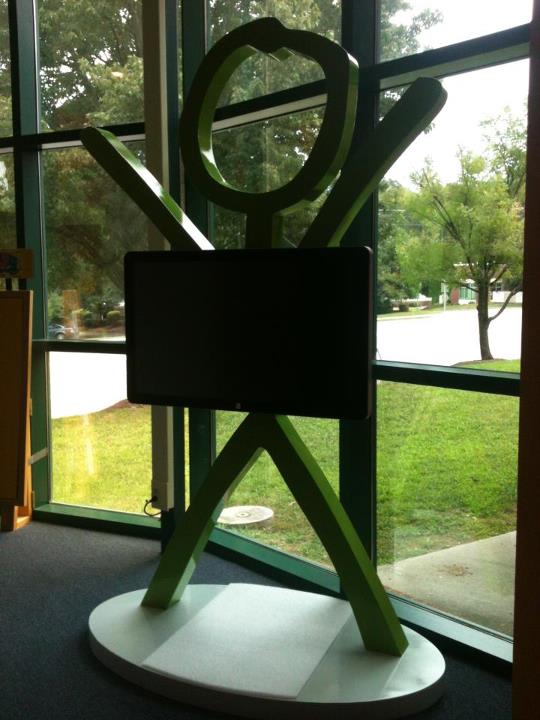
"Hey Dude, I’m Seymour…Seymour Poe to be exact…your inside the body - brain, heart and lung expert.…hard to believe maybe, given I’m a green stick figure, with a computer for a belly…but don’t judge a stick by its…belly…well, you know what I mean!”
And Seymour Poe is just that! Standing a full 7 1/2 feet tall, Seymour is now welcoming visitors to the Alice Aycock Poe Center for Health Education in Raleigh. He is the Poe Center's giant green mascot with a super-sized touch screen attached. Now visitors to the Poe Center will be able to learn all about the dangers of tobacco use as well as tips for those who are trying to quit through this newest of the Poe Center's interactive independent learning displays.
My Childhood Visit to the Poe Center
My Childhood Visit to the Poe Center
By C. Marie Duncan, Poe Center Board of Directors Secretary
“We get to leave school today?”
“Yep, and we’re all riding on a bus!”
“What about lunch?”
“We get to eat lunch outside on a playground!”
“Where are we going?!”
“We’re going to Poe!”
Ok, maybe I don’t recall the exact conversation 20 or so years ago, but I do remember the excitement of elementary school field trips. It’s no secret students of all ages love a change to their normal school day – and leaving the school grounds for pretty much any other destination is just thrilling.
In my 13 years as a Wake County Public School student, I attended many field trips. We visited various museums, the zoo, and even a water treatment facility. I can remember snippets here and there, but our visits to the Poe Center stand out the most.
The demonstrations fascinated me, each theater offering another view into the human body from a different perspective. Today, as a volunteer, I witness the passion shared amongst Poe Center staff and health educators; no matter what technology the Center offers, it is this passion which will remain one of Poe’s best assets (well, that and the BRAIN!).
I feel fortunate to have grown up close by the Center. Now I hear about school groups traveling across the state to attend. The Center truly strives to serve the entire state, and we are always brainstorming ways to get the word out to counties outside the Triangle.
When I was asked to consider volunteering with Poe, I jumped at the opportunity. As an aunt with two young nieces, and one sister in education herself, I hold a strong interest in supporting any efforts to improve health education. The Poe Center had a positive impact on me, and I certainly hope my nieces enjoy a similar experience. Learning about how to establish and maintain healthy behaviors will serve my nieces well beyond their youth. In fact, one day they will likely pass on their knowledge to their own children.
And who knows, maybe my nieces’ children will take a field trip with your own grandson, granddaughter, niece, or nephew?!