
Bouncing Back: How to Build Resiliency Skills
Bouncing Back: How to Build Resiliency Skills
By Paige Schildkamp, BA, MPH - Health Educator
This year, the Poe Center presented the our first sessions of the Youth Empowerment through Action and Resiliency for Generation Z (YEAR Z) Program Series. This program series covers topics from Poe’s Family Life, Substance Use Prevention, and MindWell Mental Health topic areas, coupled with an introduction to resilience concepts and resiliency-skills practice.
We’ve said it ourselves and heard it over and over. If there was ever a time that tested our ability to be resilient, this past year was it. Dealing with the difficulties, complications, and sadness brought on by the COVID-19 pandemic has caused stress and hardships for many people worldwide. Young people have not been exempt from this suffering as many continue to experience social isolation and loss. With that in mind, the resiliency skills discussed and practiced in Poe's YEAR Z series are more important now than ever. These are skills that can and should be practiced every year - all year.

Parents are often the most effective instructors for resiliency skills. You are your child's biggest role model. The more resilient and self-regulated you are, the better you’ll be able to help the youth in your life find that same resiliency for themselves.
Here are a few key resiliency skills that you and your youth can practice together. Some of these you may already be doing, but haven’t thought about them in this way. Some may look familiar, but be called something a different. Some may be totally new to you. Ultimately, everyone is different and what works for you may not work for your youth (and vice versa). Trying these skills and practicing together, until you find and improve on your favorites, is important to developing life-long habits.
- Connection: Try to set aside a little time every day, even a few minutes, to check in with each other. This helps creates opportunities for youth to come to you when they need to without it having to be awkward or unordinary. Connection with a trusted adult (or a close friend, if you’re the adult) is a central tenet in successful resiliency.
- Resource: Find a positive memory that makes you feel good. Use that memory as a mental “escape” when facing a difficult decision or stressful situation. Use your five senses to really sink into that memory's place or time: Who was there with you? What did you see, feel smell, and hear? What are the feelings you had during that memory? Try out this video to get you started.
- Reset: No matter how prepared you are, there will be times when you get knocked out of your “resilient zone.” That’s ok! Resiliency skills help you "bounce back" and manage your thoughts and feelings so you can feel calmer and focused. Try these "reset" strategies until you find a few that work well for you.
 Press your hands or back against a wall or other hard surface.
- Count backwards from 20.
- Name six colors that you can see.
- Use tempo breathing. Try this box-five breathing video.
- Close your eyes and notice the sounds around you.
- Walk around and focus on your feet as they touch the ground.
- Rub your hands together and focus on the way it feels.
- Be Proactive: If you know a certain event or feeling is likely to cause you stress, make a resiliency plan ahead of time: Who can you get in touch with for support? Is there a way to take a break from the situation? What reset skills work best for you? Simply having a plan may be its own source of comfort. Things may not go according to that plan, but you’ll be better equipped to handle stress that does arise. This mini-lesson from the Poe Center explains how certain feelings can cause you to over-react to situations causing them to become stressful and how to manage those moments.
- Take Breaks: When you're busy and feeling overwhelmed, this may seem impossible. But taking a break from the stressful activity can really help. Try taking 20 minutes to power nap or walk, listen to some music, stretch, call a friend, meditate, watch a short tv show, or anything else that can help your mind and body a rest.
- Practice: Practice these skills on your own and together with your youth. Just like any other skill, these take time and effort to learn. You may already be doing some version of these strategies and only need to fine-tune them. Or you may find something new that you love and can add to your resiliency toolbox.
Follow us on Instagram @Poe_Center for more resiliency tips and ideas from our partner, @WeThinkTwice.
View this post on Instagram


Summer Smiles
Summer Smiles
Alaina Hart, MPH, CHES
Senior Health Educator
Dental Health Program Manager
Summer fun is in full swing, but don’t let tooth decay ruin your plans! Even though your days may be spent enjoying the warm weather or hanging out with family and friends, it is important to remember to keep up with your dental hygiene routine - especially for kiddos. Here are a few reminders for parents to help prevent tooth decay for the little ones.
Keep A Routine
 If you spent a lot more time in the house this past year, like many of us have, it may have been an adjustment to help your kids keep up with their dental hygiene routines, especially if they were used to rolling out of bed and turning on the computer. Now with many businesses and activities open again for the summer, it can be easy for children to get off track with regular brushing and flossing, yet again. The extra time on your hands in the summer is actually a great time to work on brushing and flossing skills. If daily toothbrushing is like "pulling teeth" in your house, here are 3 ways from Colgate to make it fun and more sustainable.
-
- Brush against the clock: Set a two-minute timer and have a brush party. This not only gives children something to focus on, but it also helps them start to understand how long they should be brushing their teeth.
- Brush to your favorite song: Most children have a favorite song that makes them smile when it comes on. Pick a two-minute song to play for kids while they brush their teeth. If the song is longer, use the extra time for a rinse break. There are also many children’s characters that sing songs about brushing. Here are several fun songs to add to your toothbrushing playlist.
- Brush during commercial breaks: If your child has a favorite morning or evening show to watch, commercial breaks allow plenty of time for both brushing and flossing. The average commercial break is between two and three minutes. As soon as the commercial starts, children can head to the bathroom to brush and floss and be back to catch the rest of their show.
Snack Smart

The Poe Center loves teaching about healthy snacking, but we know that summertime can make it tempting to load up on lots of frozen sweet treats. Remember, water (especially if it has fluoride) is always a great first choice to stay cool, hydrated, and keep teeth happy and healthy. If you want to add some excitement to your water, different fruits and herbs, like mint and lemon, add lots of flavor without adding sugar. You can even make your own frozen "popsicle" treats with 100% juice and real fruit. Summer is also a great time to enjoy the many fruits and vegetables that are in season and keep children, who usually like to graze all day, satisfied with healthy choices.
Schedule Appointments Early

Summer is a great time to schedule your children’s dental appointments to help avoid the back-to-school rush in the fall. Dr. Hayes with the American Dental Association says, “We can help spot and take care of any issues, so your child doesn’t have to miss class once school starts.” Regular visits to the dentist during the summer can also help you avoid dental emergencies, especially while on vacation.
Although brushing and flossing is important all year long, sometimes children need helpful reminders in the summer. Another great way to motivate children to keep up with their dental hygiene routine is to let them pick out a new toothbrush to kick off the summer season. Keeping these simple reminders handy can help make sure your child’s smile stays bright all summer long. Wishing you a happy, healthy rest of your summer!
Resources:
3 Teeth Brushing Timer Activities for Kids
3 Tips for Healthy Summer Smiles
Featured Poe Program: Sheriff Tuffy Tooth
 Participants: Preschool - 1st grade
Program Length: 30 minutes
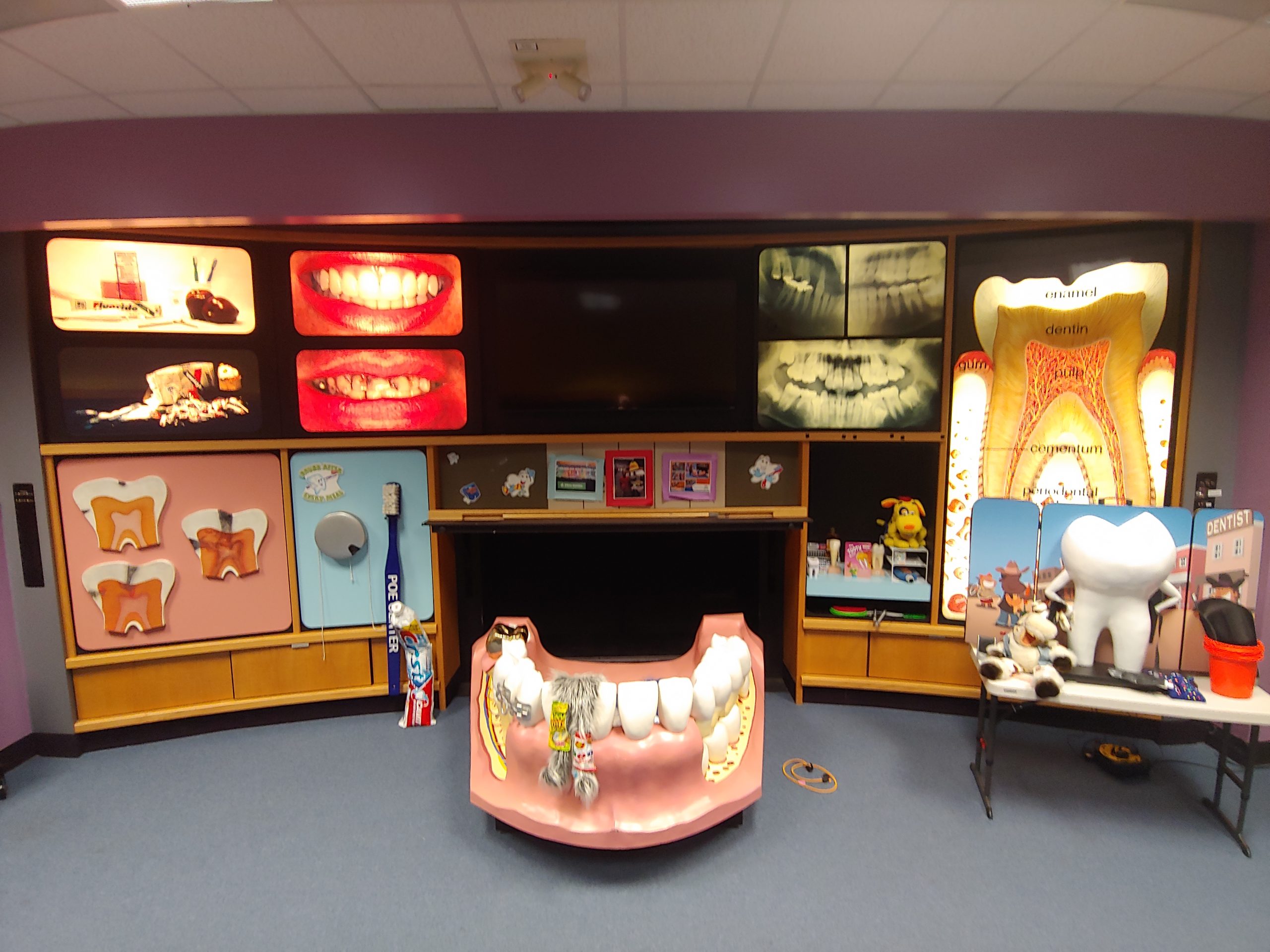
Sheriff Tuffy Tooth speaks to kids about the importance of tooth brushing, eating healthy foods, and visiting the dentist. Invite the Sheriff, an animated, talking tooth and his deputy, “Bucky the Horse,” to visit your school or group for a one-of-a-kind experience!
Programs can be presented online and are great for youth and family groups to participate from home. Call (919) 231-4006 for details.
Featured Activity: Dental Health Videos
How to Floss:
Tooth Brushing Song with a Countdown Timer:
Poe’s 30 “Pearls of Wisdom” - In Honor of Poe's 30th Anniversary
Poe’s 30 “Pearls of Wisdom”
Emily Hoover, Intern

The Poe Center is celebrating 30 visionary years of health education. Since opening the doors to our one-of-a-kind field trip destination in 1991, Poe has grown into a precious pearl for North Carolina. Pearls grow by creating new and stronger layers year after year. Just like a pearl, Poe has created a stronger healthier North Carolina educating each new generation year after year reaching more than 1.3 million children during the last 30 years.
To celebrate this special milestone, here are 30 “Pearls of Wisdom” Poe teaches in our programs to build a healthy North Carolina
1. Drink More Water.
Did you know over 60% of your body is made of water? Check out our Drink More Water campaign and facts.
2. Rethink Your Drink.
The Centers for Disease Control and Prevention (CDC) states that “Sugar-Sweetened Beverages (SSB) are the leading sources of added sugar in the American diet.” See more about drinks and how they relate to your health.
3. No bees. No food.
Did you know 70 of the world’s top 100 crops, including almonds, blueberries, and peaches, are pollinated by bees? The Poe Center has three bee hives and an outdoor “pollinator” classroom, made possible with our partnership with Bee Downtown.
4. Stay Active.
Kids need 60 minutes of physical activity every day, and adults need at least 30. Follow #PoeFit on Twitter for tips on keeping you and your family active.
5. Eat a rainbow of fruits and vegetables.
Eat a variety of fruits and vegetables. Here are 10 tips on how to eat healthier. Then, check out #PoeFitNutrition on Twitter for regular advice on maintaining a healthy diet.
6. Vaping is not worth the risk.
Studies show that vaping damages the lungs; and its substances, such as nicotine, negatively affect growing brains. The Poe Center offers a Vaping 101 series for 6th-12th graders.
7. Social media and the brain. Know the facts!
The current generation of adolescents is growing up in a media-saturated world. Research shows social media affects the developing brain. Learn about current research on adolescent brain development and teen risk perception with Poe’s #YouthCulture program: Adolescent Brain Development and the Role of Social Media.
8. Recognize the warning signs of unhealthy relationships
It is reported that one in three teens will experience dating violence. Find information on the importance of healthy relationships and the dangers of unhealthy ones with Poe programs such as Healthy Relationships 101.
9. Understand the risk of opioids.
Prescription opioids can be addictive and dangerous. Learn about the scope of the opiate problem and the growing concern of opioid use with Poe’s #YouthCulture series program Opioids 101.
10. When it comes to bullying, don’t be a bystander.
Adults, parents, school staff, and kids can work together to prevent bullying. See Poe’s Bullying Prevention programs and resources.
11. Brush your teeth two times a day.
Tooth decay is one of the most common chronic diseases of childhood. Check out Poe’s Dental Health programs and resources.
12. Foster healthy friendships.
At any stage in life, friendship is something to cherish. The Poe Center works to help children recognize healthy friendships through the program Friend Power.
13. Lock your meds.
Prescription drugs and household chemicals can be dangerous for members of your home. Ensure safety in your home by checking out Poe’s online Medicine Safety exhibit.
14. Connect with your cranium.
Did you know your brain weighs about three pounds and controls just about everything you do, even when sleeping? Learn about the different parts of the brain and what they do with our Cranium Connection exhibit and resources.
15. Cook with your family.
Cooking and kitchen skills can help develop better food choices, preferences, attitudes, and behaviors, positively affecting children’s health and long-term health outcomes as they grow. Check out our virtual CookWELL kitchen, programs, and resources.
16. Compost, compost, compost.
Don’t waste your food scraps! Learn to use food waste to enrich your garden. See the composting section in Poe’s kitchen and cooking resources.
17. Grow your own food.
Gardening can be a valuable activity that promotes positive lifelong health outcomes. Check out Poe's GrowWELL garden programs.
18. Recycle!
Properly recycling milk jugs, water bottles, egg cartons, and other common household items is an easy way to positively impact the planet. Learn more with these recycling resources.
19. Reduce your risk of foodborne illness.
Maintaining home refrigerators at 40°F or below is one of the most effective ways to reduce the risk of foodborne illness. Store fresh fruits and vegetables, meats, and dairy products properly so they stay fresh and no one gets sick.
Check out these refrigeration and food safety tips.
20. Wash your hands.
Handwashing is more important than ever. Wash your hands for at least 20 seconds with soap and warm water to properly get rid of germs. If you have kids, make handwashing a fun part of their daily routine by singing the birthday song each time you wash.
Watch the Poe Center's video on proper hand washing, and visit our website for information on Poe’s GermBusters program for 2nd and 3rd graders.
21. Learn to make a few simple nutritious meals and snacks.
Having a few go-to nutritious recipes makes it easier to plan and cook healthy meals. Download some of Poe's favorite recipes.
22. Talk to your kids about puberty.
Poe's popular Girl Talk/Guy Talk parent-child workshops are designed to help facilitate positive open communication about adolescent development and the changes boys and girls experience during puberty. Visit our calendar to see our upcoming events.
23. Go outside and play.
North Carolina is filled with wonderful parks and play spaces for you to go. Take your family, go by yourself, and get some fresh air.
WakeMED and the Poe Center worked together to create a one-of-a-kind health education play space located at Poe’s facility. Check out WakeMED’s PlayWELL Park.
24. Tap into the power of positivity.
Choosing a positive approach to life is proven to have long-term health benefits and outcomes. Read these 10 tips for increasing positivity and reducing stress.
25. Develop a stress management plan.
Stress is a natural part of life. Developing healthy ways to cope with stress helps you and creates a good example for the teens and youth in your life. The Center for Parent and Teen Communication has a great resource to help your teen build a stress management plan.
26. Be resilient and cope with stress.
Every day presents new challenges, especially during a global pandemic. Stress can be hard to cope with. Learn more about coping with stress during COVID-19.
27. Reduce the risk of addiction.
Alcoholics Anonymous of NC reports that more than 450,000 individuals suffer from alcohol addiction or abuse in North Carolina every year. Almost 40,000 of these people are teenagers.
Check out Poe's Substance Use Prevention programs.
28. Prepare your daughter for college.
College freshman year is full of new situations that put young women at risk for adverse health outcomes. Gain helpful insights and resources with Girl Talk 3, a workshop for moms and daughters preparing for college. Learn about campus safety, binge drinking, peer pressure, and more with this program coming to the Poe Center soon!
29. Parents you matter!
Parents are the biggest influence on their children’s education and health choices. Poe has programs geared towards adults and parents. Click on the “adults” option for a list of programs specifically for you.
30. Celebrate the Poe Center’s legacy!
North Carolina artist Nicholas Bragg created a one-of-a-kind commemorative mural which captures Poe’s past, present, and future within the context of world history. Located just inside the front doors of the Poe Center, the mural, entitled “A Celebration of the Alice Aycock Poe Center for Health Education," welcomes all visitors. You can also visit an interactive online version of the mural.

Have Safe Fun in the Hot Sun!
Have Safe Fun in the Hot Sun!
By Katie Barker and Will Florence, Health educators
Looking to have some fun this summer - safely? We have a few tips for staying safe out in the heat this summer.
At the beach: Being at the beach or pool is a great way to get your family active and stay cool during the summer. Plus, swimming is a great way to encourage your kids’ imagination. Challenge kids to swim like a mermaid or an octopus. It’s also important to keep these tips in mind while enjoying the cool water.
- Teach children not to swim alone, even if they are strong swimmers.
- Keep younger children within an arm’s reach of an adult, and always make sure an adult is supervising older children.
- Wear “coast-guard-certified” life vests when needed, such as during boating (floaties, water wings, etc. are not a sufficient substitute).
- Skip breath-holding games because these can lead to hyperventilation.
- Avoid pool drains that can potentially trap bathing suits or hair with their suction.
- Avoid swallowing water while swimming as it may contain germs.
- Check the depth of the water before diving. Look for signs at the pool that say “no diving,” which will indicate the water is not deep enough.
- Walk carefully around the edge of the pool to avoid slips and falls.
- Bring a healthy snack and drink water, as swimming takes a lot of energy.
On a hike or playing outside: Hiking is another great family activity. Let your kids “lead” the adventure as you walk along the path. Keep these safety tips in mind:

- Avoid poison ivy, oak and sumac, and wild parsnips.
- “Leaves of three, let them be.” Poison ivy leaves always appear in bunches of 3’s.
- “Longer middle stem, don’t touch them.” The middle leaf typically has a longer stem.
- “Hairy vine, no friend of mine.” During the leafless season, poison ivy can be found on tree trunks, rocks, and other structures with a hairy vine.
- Remember, these leaves are quite glossy and edges are smoothed or toothed.
- Leaf colors can vary from red in the spring and summer, to yellows and oranges in the fall.
 Look out for snakes.
- “Red on yellow, dangerous fellow; red on black, friend of Jack.” This is a good way to remember which snakes are poisonous. However, stay aware of other snakes which are poisonous that have neither red nor yellow markings, such as copperheads.
- It is best to avoid snakes altogether and teach children to alert an adult if a snake is spotted.
- Avoid reaching under areas where one cannot see, such as underneath rocks or woodpiles. Snakes and spiders like to hide under these types of places.
- Beware of ticks
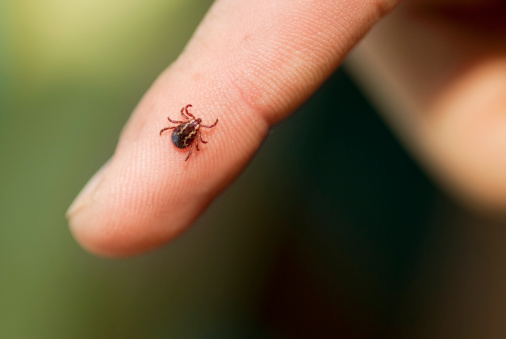
- Ticks can hide in children’s hair and can move to areas under clothing.
- Be sure to have an adult check for ticks after playing in wooded areas. If a tick is identified, use tweezers to remove it and wash the area with soap and water.
- Be friendly with bees.
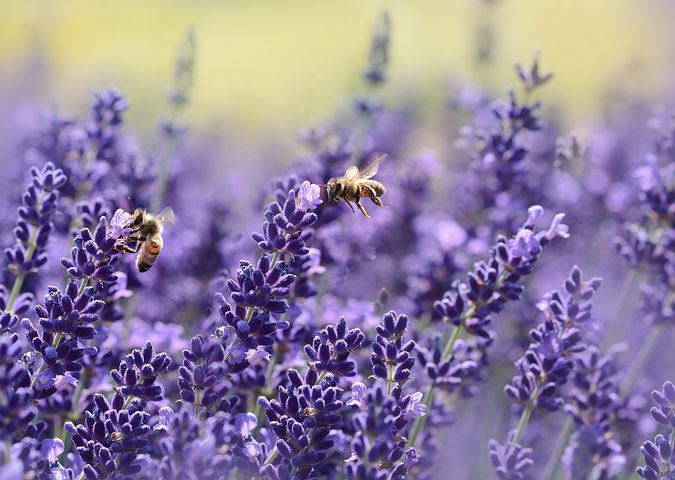
- Children should not try to swat or shoo away bees, wasps, hornets, or yellow jackets.
- Move away from bees or hornets if spotted.
- If stung, scrape stinger away with fingernail or credit card. DO NOT use tweezers as the stinger can burst under the skin and cause more damage.
- Wash with soap and cool water.
- Apply an ice pack or cold cloth and cover with lotion.
- Seek medical attention if there are changes in breathing, vomiting, or fever that occurs.
- Watch your step for fire ants.
In the sun: Enjoy the sunshine and soak up some Vitamin D this summer. Keep these tips in mind to take care of your skin. It’s our largest organ.
- Limit sun exposure between 10 A.M. and 4 P.M. when sun UV rays are strongest.
- Regularly apply sunscreen, and re-apply throughout the day.
- Choose a sunscreen with an SPF of 15 or higher, and for best results, use broad-spectrum sunscreen which cancels out both UVB and UVA rays.
- It is important to remember that sun rays can still be absorbed on both cloudy and sunny days. So wear sunscreen even on overcast days.

- Apply to any areas that are exposed, such as the face (eyes, ears, nose), arms, feet, and legs.
- Sunscreen should be applied at least 30 minutes before exposure to the sun so it has time to absorb and be reapplied every hour or more frequently if in water.
- Choose sunglasses that are 99% UV radiation resistant and shatter-resistant.
- Try wearing a hat with a brim to shield your face from excessive UV rays.
Resources:
How to Recognize and Avoid Poison Ivy: Three Sayings to Remember
Caring For Our Children: Health Promotion and Protection, Sun Safety
Featured Poe Program: Summertime Safety

Participants: Kindergarten - 5th
Program Length: 45 minutes
Safe outdoor fun is the focus of this program. Children learn about protection from the sun, signs of overheating and dehydration, safe warm weather exercise and nutrition, poisonous plants, bug bites, and more. Be active, stay safe, and have safe fun in the hot sun.
Programs can be presented online and are great for youth and family groups to participate from home. Call (919) 231-4006 for details.
Featured Activity: Summertime Safety Videos
Poison Ivy Safety:
Water Safety:
Bug Safety:
Honoring National Prevention Week 2021
Honoring National Prevention Week 2021
By Tamika Gilchrist, Senior Substance Use Prevention Specialist
What is National Prevention Week (NPW)?
NPW is an annual health observance dedicated to increasing public awareness and action around substance use prevention and the promotion of positive mental health. This year, this national initiative, sponsored by the Substance Abuse and Mental Health Services Administration (SAMHSA), will take place May 9th-15th.
Why is prevention so important?
Prevention is important because it delays the onset of the first use of alcohol, tobacco, or other drugs. This ultimately protects the growing brain and body during adolescence. Prevention also contributes to positive health behaviors and healthy lifestyles. Each year, NPW incorporates daily health themes to focus on pressing substance use topics. These themes are highlighted this week to increase awareness but the conversations need to be ongoing to support the health and wellness of our families and our communities. The 2021 daily health themes are:
Monday: Preventing Prescription Drug and Opioid Misuse
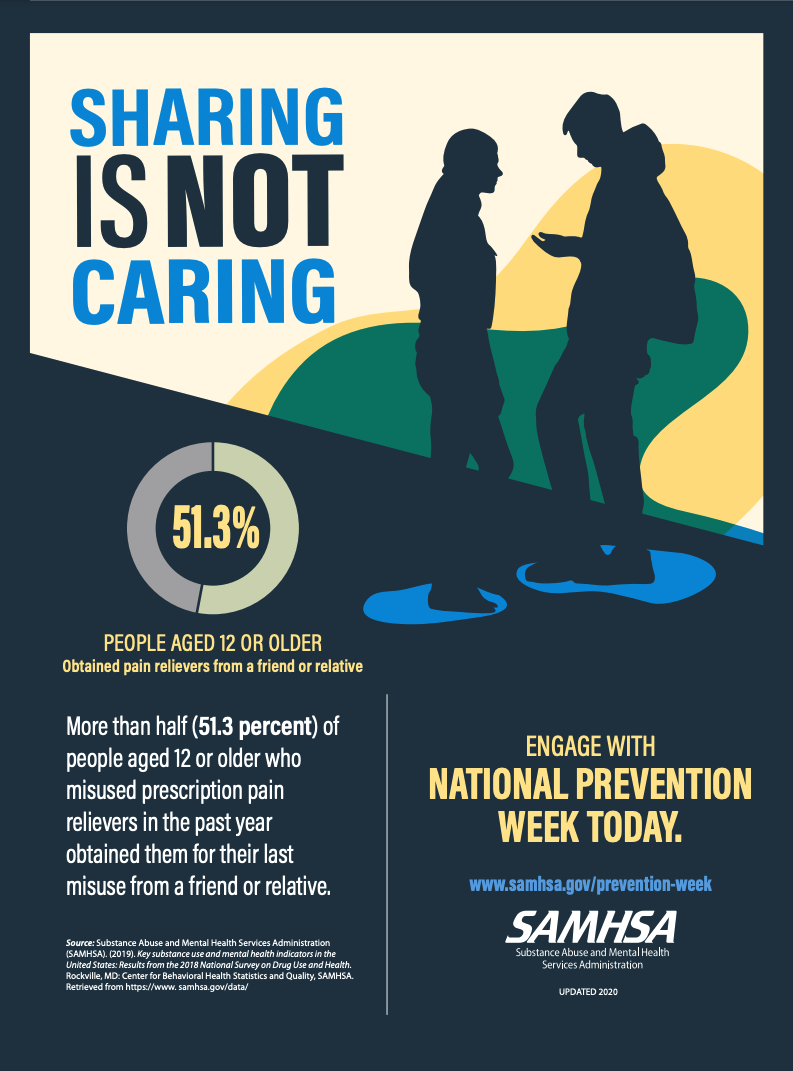 Securing and monitoring medications supports proper medication use by intended users and prevent unintentional access and misuse. Here are a few tips to help secure and monitor medications in the home:
- Use a medication lock box or pouch.
- Use a locked cabinet.
- Use a locked closet.
- Keep out of reach of others.
- Count and make sure you follow all instructions for the medication.
Disposing of unused and expired medications from the home also prevents unintentional access and misuse. Proper disposal prevents unintended access and is safer for the environment by preventing medication from entering water sources. Here are a few tips to help dispose of medications properly:
- Find a secure, locked drop box in your community or take the medication to your local pharmacy and ask them to dispose of it properly.
- Use a medication disposable bag (deactivation kit).
- Avoid flushing medication down the toilet or in the sink.
- Avoid disposing of medication in the trash can unless using a deactivation kit.
- Never give your medication to anyone else. The medication is prescribed and/or recommended for you according to your medical needs.
For Information on Drop-Off Locations:
Wake County: Find a dropbox. | Across North Carolina: Maps of locations | For more information: Visit www.lockyourmeds.org/NC
Tuesday: Preventing Underage Drinking and Alcohol Misuse
Alcohol is the most-used substance and the leading cause of death among youth in the United States. More teens die as a result of alcohol use than all other illicit drugs combined. In North Carolina, 12% of teens had their first drink of alcohol before the age of 13. If you are wondering how you as a parent, caregiver, and other adults can do to prevent underage drinking and alcohol misuse, keep reading!
Ongoing conversations around the dangers of alcohol and other drugs are needed. Using the opportunities of everyday life as reasons to naturally bring up the conversation is vital. Demonstrate that you are a great source to receive information, show that you care about their wellbeing and growth, and help build their skills to avoid alcohol and other drug use. Utilizing role-play scenarios to practice creative ways to refuse or say “no” to being offered alcohol can help build the confidence and skills to abstain from alcohol consumption.
Check out this video for ideas on how to start the conversation. For more information on how to talk to the children and youth in your life, visit Talk. They Hear You and download the app for interactive scenarios and tips.
Talk it Up! Lock it Up!TM is an innovative strategy to change the physical environment relative to youth access to alcohol in homes. If you have alcohol in your home, ensure it is secured to prevent easy access by youth. Here are a few tips:
- Monitor the alcohol that is in your home by taking inventory and being aware of the amount and types of alcohol available.
- Ensure alcohol in the home is not easily accessible. Secure alcohol by placing it in a locked cabinet or closet. If you have a fridge for wine or beer, consider adding a fridge lock. Cabinet locks and fridge locks can be purchased at your local hardware store or online.
Take the pledge to Talk It Up. Lock It Up!™ and encourage others to take the pledge and start the conversation today!
Wednesday: Preventing Illicit Drug Use and Youth Marijuana Use
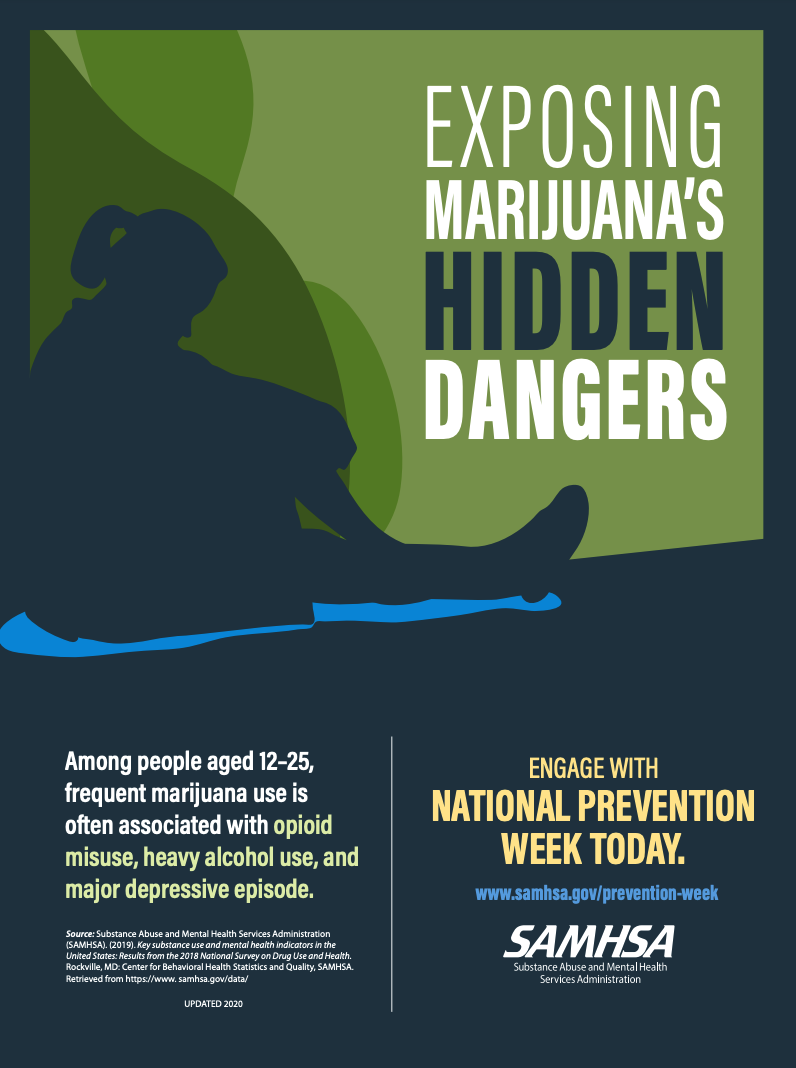 According to the National Youth Risk Behavior Survey (YRBS), in 2019, 36.8% of youth reported ever use of marijuana. 21.7% of youth reported current marijuana use (one or more times during the 30 days before the survey). Marijuana use has short-and-long-term effects on the brain. In addition to a wide range of effects physically and mentally.
The YRBS report also showed that 3.9% of youth have ever used cocaine and 7.0% of youth have ever used a hallucinogenic drug such as LSD at least one or more times during their life. Many illicit drugs pose major health risks and can cause addiction after a single use. Illicit drug use can impose short-and-long-term consequences including damage to relationships and friendships, lack of motivation to maintain grades in school, legal consequences, and death. It is important to be up to date on drug trends and facts. NIDA for Teens, SAMHSA's Tips for Teens, and the Poe Center for Health Education are all great resources to utilize.
Thursday: Preventing Youth Tobacco Use (E-cigarettes and Vaping)
The Center for Disease Control (CDC) reports that due to e-cigarette/vaping use, thousands of people in the U.S. have been hospitalized with serious lung injuries. As of February 2020, 68 deaths have been confirmed in 29 states and the District of Columbia. There are more deaths under investigation.
Quitline: By phone: 1-800-QUIT–NOW (1-800-784-8669) | Online: QuitlineNC.com, | Quitline Resources during COVID-19
Text to quit vaping: Text DITCHJULL to 88709
Friday: Preventing Suicide
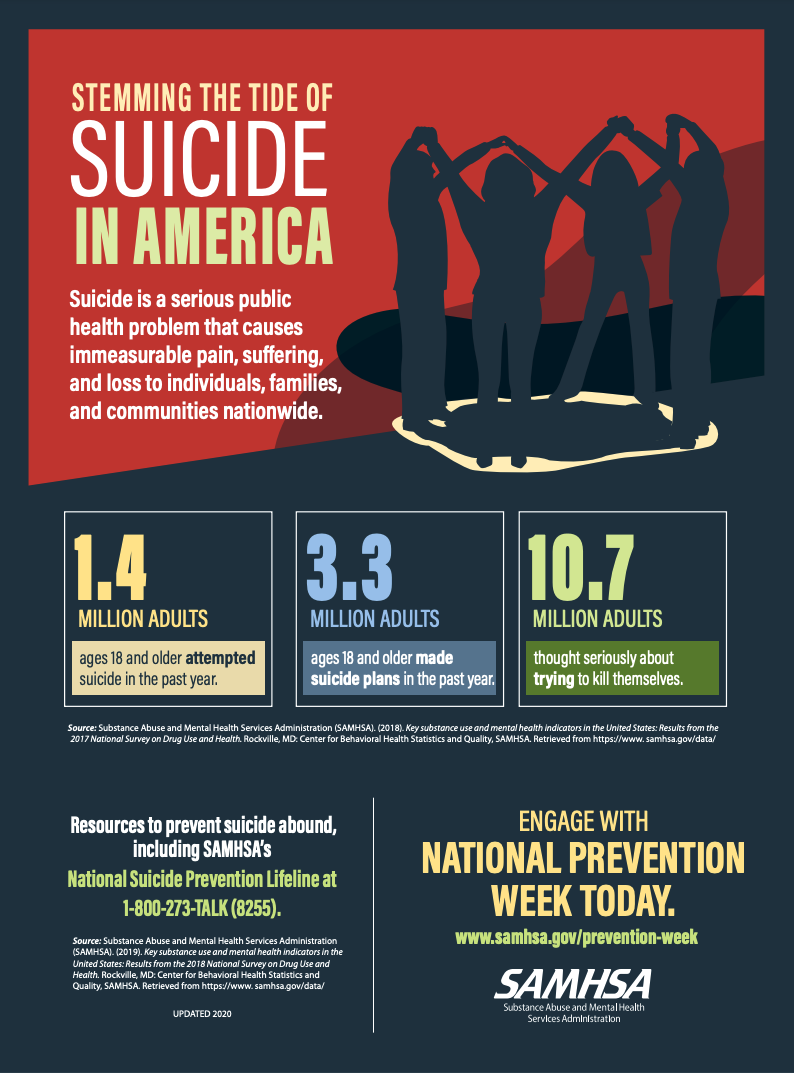 According to the Centers for Disease Control and Prevention, suicide is the 10th leading cause of death in the United States. It was responsible for more than 47,500 deaths in 2019, which is about one death every 11 minutes. Warning signs for suicide include:
- Talking about feeling trapped or in unbearable pain.
- Talking about being a burden to others.
- Increasing the use of alcohol or drugs.
- Acting anxious or agitated; behaving recklessly.
- Sleeping too little or too much.
- Withdrawing or feeling isolated.
- Showing rage or talking about seeking revenge.
- Displaying extreme mood swings.
Protective factors are personal or environmental characteristics that help protect people from suicide. According to the Suicide Prevention Resource Center, major protective factors for suicide include:
- Effective behavioral health care.
- Connectedness to individuals, family, community, and social institutions.
- Life skills (including problem-solving skills and coping skills, ability to adapt to change).
- Self-esteem and a sense of purpose or meaning in life.
- Cultural, religious, or personal beliefs that discourage suicide.
If you or someone you know is in crisis, please contact the National Suicide Prevention Lifeline. Both resources are free and confidential: 1-800-273-TALK | Online Lifeline Crisis Chat
Resources for Prevention Week:
 SAMSHA’s National Prevention Week 2021 - Learn more about National Prevention Week
CDC.gov/suicide/facts - Learn more about how suicide affects us.
SAMHSA. Talk They Hear You. - More about underage drinking and preventing it.
QuitlineNC.com - Quit smoking or vaping today.
LockYourMedsNC - Lock up your medications or find a drop-off location.
Trends in Prevalence of Marijuana, Cocaine, and other Illegal drug use National YRBS
Featured Poe Program: For the Health of It!

Participants: 6th - 8th
Program Length: 60 minutes
Participants will discover how using drugs and alcohol can damage their brains and bodies. This program is centered around interactive activities that focus on “showing and not telling” kids how their brains are affected by alcohol and drug (inhalants, marijuana) use. Real-life scenarios are used to help participants analyze how a “drugged” brain affects their actions and decision-making skills. Participants will also engage in role-play, reinforcing refusal skills.
Programs can be presented online and are great for youth and family groups to participate from home. Call (919) 231-4006 for details.