
Your Mouth Matters: Dental Health Tips for Kids and Families
Your Mouth Matters: Dental Health Tips for Kids and Families
Chelsea Kolander, MPH/MSW - Health Educator, Dental Health Theatre Manager
Alaina Carter, CHES - Health Educator
A bright smile and healthy teeth aren’t the only benefits of good dental health habits. Proper oral care also impacts academic performance and general health. According to Delta Dental:
- “Tooth decay is the most common chronic childhood disease in the country, and every year children miss 51 million hours of school because of oral health problems.”
- “Gingivitis, an early stage of gum disease, occurs when bacteria in the mouth grow into plaque, causing inflammation and bleeding in the gums. When left untreated, the plaque can spread below the gum line, allowing bacteria to enter the bloodstream, which increases the risk for systemic diseases, such as heart disease.”
- “Research has found a strong connection between periodontal (gum) disease and diabetes. Proper care of the mouth, including treatment of gum disease, may even help diabetics achieve better blood sugar control.”
Ten Tips for Terrific Teeth AND Good Health
Taking care of your mouth is an investment in taking care of yourself and your family. Here are a few tips for good oral care recommended by the American Dental Association, American Academy of Pediatric Dentistry, and New York University College of Dentistry.
- Sharing is not caring when it comes to dental health. Do not share eating utensils nor “clean” a pacifier by putting it in your mouth. This can spread bacteria that can cause cavities in your child’s mouth.
- Drink fluoridated water or ask your dentist if a fluoride supplement is needed to promote the formation of strong, healthy teeth.
- After feeding your infant, clean your baby’s gums with a damp washcloth to prevent the buildup of plaque (soft, sticky bacteria) that can cause tooth decay. Don’t allow your baby to sleep with a bottle or pacifier, as this can also cause tooth decay/cavities.
- Take children to the dentist no later than their first birthday for a check-up. Ask the dentist about applying dental sealants to prevent cavities on the surfaces of teeth. Visit the dentist twice per year unless your dentist says otherwise.
- As soon as teeth come through the gums, teach your kids to brush twice a day for two minutes each time. Use a thin layer of toothpaste for kids under 2. Assist them until they can hold the toothbrush on their own, but continue to supervise proper brushing and flossing (once a day, as soon as teeth are in contact with each other) until age 7.
- When choosing a toothbrush, look for soft, rounded bristles that clean teeth, but are gentle on gums. Kids two and up can use a pea-sized dot of toothpaste. Choose smaller toothbrushes for their smaller hands and mouths.
- Brush your teeth alongside your kids to set a good example and motivate them to brush their teeth twice a day. They will enjoy imitating you!
- Sing or play a song or recite a nursery rhyme for two minutes while they are brushing.
- Limit chewy, gooey snacks, such as raisins, fruit snacks, and candy as they can stick to teeth and increase the risk of tooth decay/cavities. Sodas and juices can wear down the enamel that protects the teeth. They can also cause acid buildup that leads to cavities.
- If your child has a loose tooth, wiggling it gently with clean hands is OK, but let the tooth come out on its own. Ask your dentist if the tooth begins to bother your child.
References:
- American Academy of Pediatric Dentistry
- American Dental Association
- "Dental Checkups Help Children Make the Grade." Delta Dental
- "Healthy Smiles, Healthy Hearts." Delta Dental
- "Making the Connection: Oral Health and Diabetes." Delta Dental
- New York University College of Dentistry
Interested in bringing this topic to your school or organization?
The Poe Center offers a wide variety of Dental Health classes for preschool – 3rd grades. Call 919-231-4006 or go on line to schedule a program.
Clean and Chompin’!
Grade Level: 2nd – 3rd | Program Length: 45 minutes
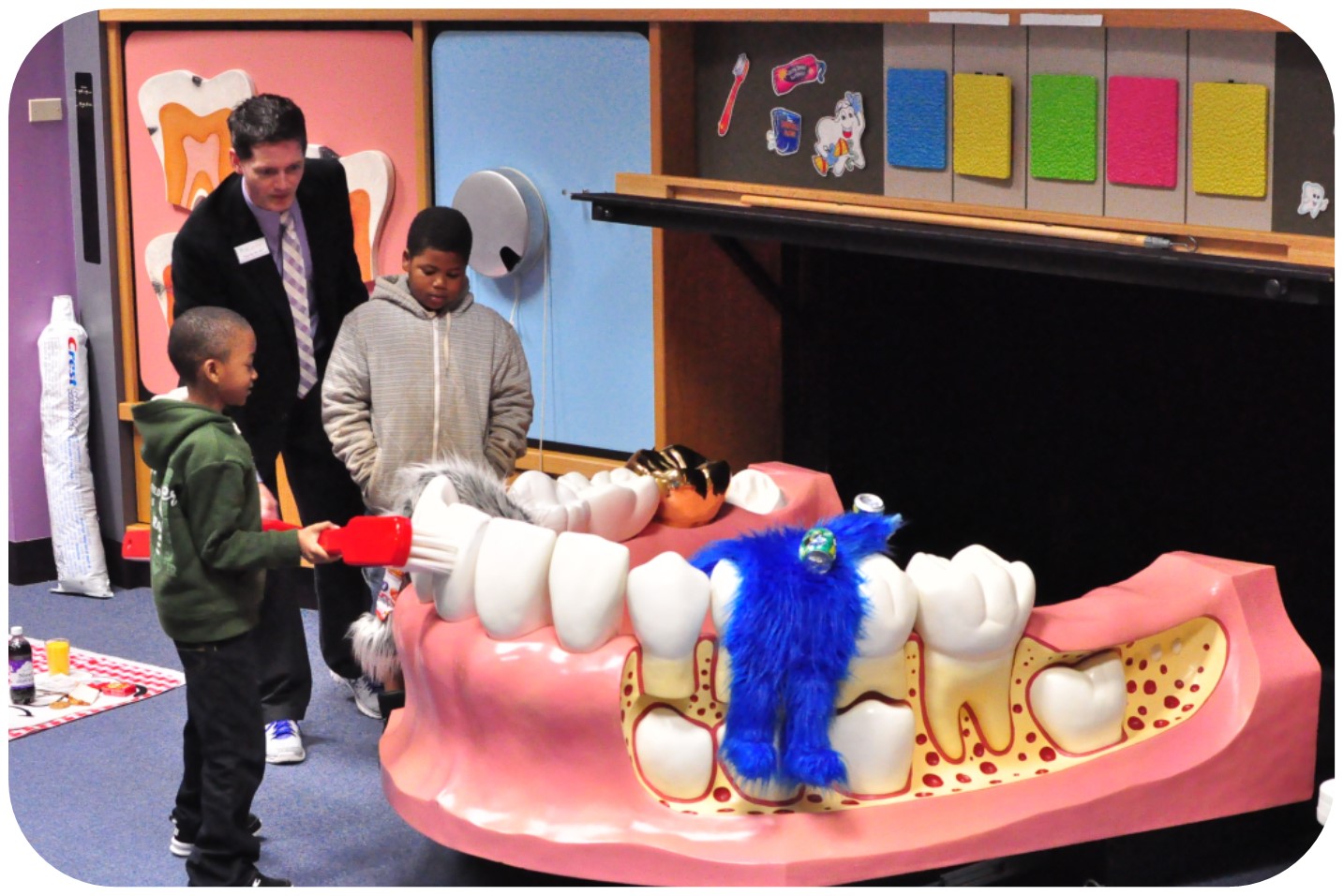
You be the dentist! Practice tooth brushing and flossing on Mr. Big Mouth’s extra-large teeth. Pick healthy habits and nutritious snacks to prevent tooth decay. To help reinforce the importance of regular dental check-ups, volunteers will create a decay equation explaining how sugar and plaque lead to cavities.
For the Classroom: Healthy Teeth Science Experiment
Grades: K-5th
Objective: For students to participate in hands-on activities that will lead them to good health conclusions
In-class time: 30-45 minutes
Materials needed:
- 2 clear cups
- water and a dark soda (ex. root beer or cola)
- 2 hard-boiled eggs per group of students
- toothbrushes and toothpaste
Steps:
1. Fill one cup with water and another with dark soda.
2. Have a student place one egg in the water container and another in the soda container.
3. Leave the eggs in containers overnight.
4. The next day, pour out the liquid in both containers and examine the eggs.
Discussion:
- How do the colors of each egg differ?
- Over time, which type of liquids do you think would be better for your teeth?
- Discuss the similarities egg shells have with our teeth and importance of brushing teeth.
- Egg shells and teeth have similar coatings, which make staining comparable.
- Just as eggshells protect eggs from breaking, tooth enamel protects teeth from decaying.
- The magic number for teeth is TWO. You want to brush your teeth at least 2 times a day for 2 minutes. - Allow students to use a toothbrush and a little toothpaste to brush away some of the soda stains.
- Why do dark liquids stain teeth? Tooth enamel is a hard substance, but has pits and ridges where food and drink particles can get stuck. Dark-colored drinks can get into those cracks and stain the teeth, which over time could cause permanent yellowish stains. Brushing teeth regularly can help reduce or prevent teeth from staining.
For more dental health activities for the classroom, visit Smile Smarts Dental Health Curriculum .
References:
- Healthy Teeth: Hands-On Science Activities. Education World.
- “Egg”stra Healthy Teeth. National Institute on Drug Abuse.
- How Does Coffee Stain Teeth? Colgate Oral Care Center.
Keeping Kids Active While Inside
Keeping Kids Active While Indoors
Cammie Bates, MPhys, LAT, ATC - Physical Activity and Nutrition Health Educator
Are cold temperatures and shorter days making the kids a little restless? Winter can be a difficult time to keep kids active when it's too cold to play outside. If they end up stuck inside with "nothing to do," there are many simple games and activities kids can play to stay active and have fun. Indoor play is also a great opportunity to let kids use their imagination for free play. The USDA recommends 60 minutes of active play every day for kids' physical, emotional, and mental health development. Here are a few ideas to get kids of any age moving.
Toddlers
- Act Out the Animals
Most toddlers love animals. Pretending to be an animal is a great way to combine movement and education. During this game, call out an animal and have your child walk, run, skip, or jump around the house pretending to be that animal. Add music and have him/her freeze in place when the music stops. Examples of pretend play may include: acting like a bear, a monkey, a flamingo, a frog, a kangaroo, etc. Use the game to share some fun facts about the particular animal. After a few tries, let your child choose an animal and you take a guess what it may be. - Have a Dance Party
Pump up the music and let the kids get loose to some fun tunes. Join them and get your exercise groove on, too. Mix up the play list with fast-beat songs to increase their heart rates and slow-beat songs to catch their breath. Improve balance by pausing the songs and having the kids strike a pose, such as freezing a pose while on one leg. Encourage them to really get active and try new moves: shake, wiggle, turn, bend down, jump up and down, move forward, backward, and side to side. Add a few “instruments” with cans, buckets, utensils, etc. to add to the fun.
Elementary School
- Build a Fort/Maze
This activity uses kids' brains and strength as they pull, tug, and stack different objects to create an indoor fort or maze throughout the house. Use pillows, cushions, or blankets. If they're old enough, try adding boxes, buckets, or even chairs. Use tape or crepe paper to build a maze. Challenge the kids to see who can move through the maze the fastest or add exercises they have to do at certain points in the maze. For instance, when they reach the middle of the maze, have them do jumping jacks, side bends, or another age-appropriate exercise.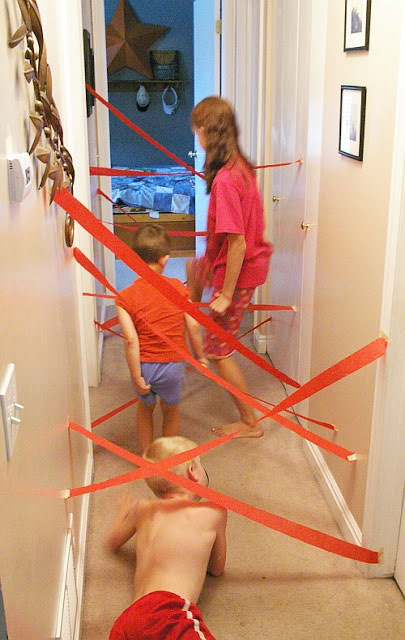
- Yoga for Kids
Yoga is not just for adults; it is incredibly beneficial for kids, too. Visit Kira Willey who sings yoga sequences for kids in her songs. Need inspiration for specific poses? Here's a list of 58 fun and easy poses complete with instructional images and descriptions. The Poe Center has also published a series of kids' yoga exercises at #PoeFit.
Middle School
- Indoor Basketball
Many kids love basketball, and it’s easy to bring the game inside. Simply get two buckets or laundry baskets and place them on opposite sides of the room. Use a pair of folded socks as the ball. Have kids pass and shoot the "ball" (no dribbling in this game). Play for a specific amount of time or points. Switch up the teams or have the kids play the game on their knees to make it more challenging.
- Balloon Games
There are many games which can be played with balloons and string. Use string to loosely tie balloons to the players' ankles. Players try to pop the others’ balloons without having their own popped. Another fun option is balloon volleyball. The object of this game is to propel the balloon over a “net” or object as many times as possible. The challenge is only one player plays at a time meaning he or she must hit the balloon from each side of the net to keep the ball in play.
High School
- Exercise Videos
There are thousands of exercise videos online your teenager and you can do together: yoga videos, ten minute HIIT or Tabata videos (timed body weight exercises), Zumba dances, and more. If your teen is creative and enjoys dancing, ask him or her to choreograph a dance routine to do later or put on a dance recital for the rest of the family.
- Workout While You Watch
If your teens want to watch TV to relax, make a deal with them. During every commercial, challenge them to do specific exercise, such as a plank or running in place, until the show comes back on or it switches to a new commercial. If you have exercise games, such as a Wii Sports or Fit, EA Sports Active, Zumba Fitness, etc., play a few rounds with them. Choose the more active ones. You’ll have fun, get exercise, and spend quality time with your teens.
Are you interested in more activities? Here are a few additional resources for more inspiration.
Cold or dreary days do not have to mean sitting inside and not playing; there are many ways to keep active, and remember spring will be here soon.
References
Davies, A. (2006). My First Yoga. Retrieved January 14, 2017.
Jensen, E. (2005, May). Teaching with the Brain in Mind, 2nd Edition. Retrieved January 14, 2017.
Make Way for Play. Scholastic.com. Retrieved January 15, 2017.
Tilak, V. (2015, September 29). The Benefits of Yoga for Kids. Retrieved January 15, 2017.
Interested in bringing this topic to your school or organization?
The Poe Center offers a wide variety of Nutrition and Physical Activity classes for preschool - 12th grades. Call 919-231-4006 or go on line to schedule a program.
Play Hard, Stay Fit
Grade Level: 2nd – 3rd
Program Length: 45 minutes
Is “play” physical activity? You bet! This session will examine the questions of “What is exercise?” and “What does it mean to be healthy or unhealthy?” Participants experience the correlation between nutrition and physical activity; calories in = calories out. They will discover their personal fitness likes and dislikes and the risks associated with poor health behaviors while learning how physical activity benefits every aspect of their lives.
For the Classroom: Travel the Tarheel State
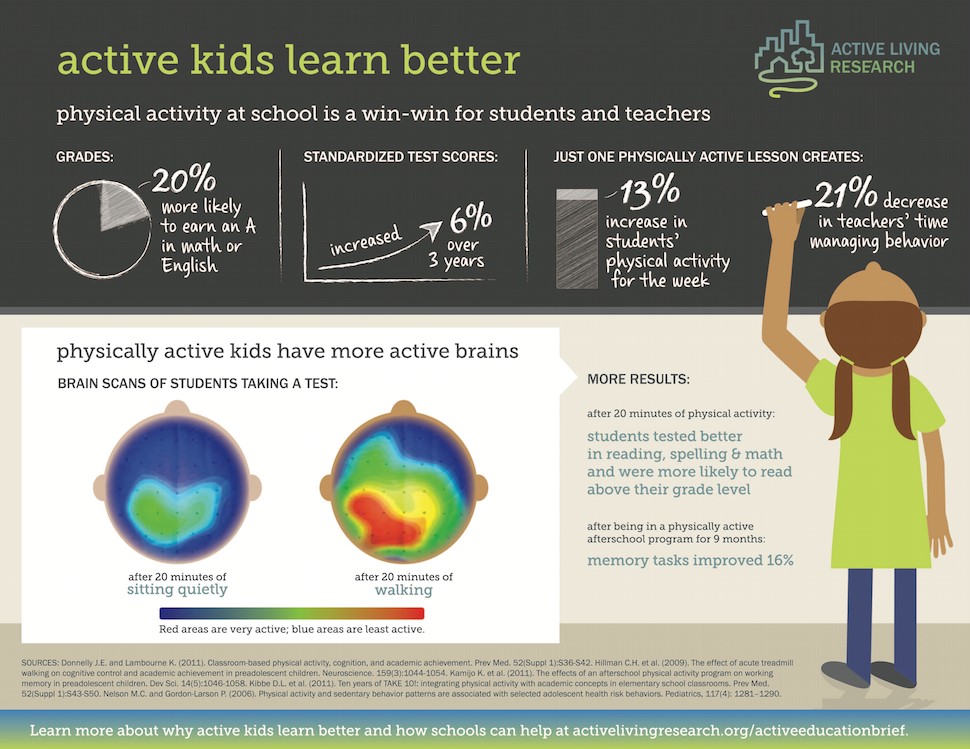
Active kids learn better. Research shows a correlation between increased movement and increased learning that extends into the classroom. There are many ways to keep kids active during the school day beyond PE classes and recess. As little as 10 minutes of physical activity during class has a positive impact on a student's ability to learn immediately afterwards. From brain breaks and energizers to activities that support subject areas, there are lots of ways to get the class moving.
Here's a creative active lesson to teach North Carolina geography. You can find this activity and many others in this helpful K-5 Classroom Energizers packet.
As you travel across the state (demonstrate using a map pointing out locations), act out these actions and more
- Hike the Appalachian Mountains
- Climb to the top of Mount Mitchell
- Raft the Nantahala River
- Act like an elephant at the NC Zoo
- Fish the Outer Banks
- Fly a kite at Kitty Hawk
- Swim in the Atlantic Ocean

For a Healthy Holiday Season: Keep it simple.
For a Healthy Holiday Season: Keep it simple.
Rachel Pohlman, MPH, RD, LDN - Nutrition Manager
Just about everyone has experienced the challenges of trying to stay fit during the holidays. It is cold and dark outside, which can discourage exercise, and indulgent food and drink seems to pop up everywhere. There are countless sources ready to bombard you with tips and tricks to manage it all. I could easily post a quick list of top 10 healthy holiday tips right now. To keep it simple, here are two comprehensive approaches that are my absolute favorites! They cover many of the smaller decisions you may make this time of year - and the rest of the year, as well.
My favorite advice is to slow down and reflect on the reason behind the celebration. My spouse and I come from different traditions and grew up with our own unique ways of celebrating the holidays. Raising kids, we quickly learned that it was too much to try to maintain every single ritual and tradition. This forced us to step back and really think about holidays and what they mean to us. We decided which holidays are important to us, what we want to teach our children, and how we want to honor the day. The deeper meaning of a holiday will be different for everyone, but ways to honor the day may include community service, special time with family or friends, religious practices, or even going for a hike for an active start to the New Year.
This leads right in to my second favorite strategy, which is to be mindful. Being mindful means you are taking the time to pay attention to your actions. You are being deliberate and putting thought into your decisions. I slowed down and was mindful about how to observe holidays. You can also be mindful about your daily activities. Are you choosing movies as your entertainment, or are you going bowling with the family instead? You can be mindful about your food. Are you grazing at the party buffet or are you making a well-chosen plate of snacks and stopping eating when you are done? Use your senses and pay attention to the flavors, textures, smells of the food instead of tossing it back and moving on to the next item. This can even increase your enjoyment of your food. Slowing down and being mindful also makes it easier to pay attention to your hunger cues. Not hungry? Stop eating and go socialize! Finally, it is very important to be mindful of your drinks this time of year since they add a substantial amount of calories. Drinks with alcohol can make us less mindful about the other behaviors and decisions we are making as well.
For those of you who were really hoping for 10 tips on staying healthy this holiday season, here you go:
- Step away from the buffet table. Take the conversations and your plate into another room.
- Get up and get moving! Dance, play with kids, walk the dog, play ball, etc. Do what gets you up and makes you happy. Make exercise part of the fun.
- Stay busy volunteering – more activity means less time to graze.
- Drink water often.
- Make less food.
- Give your recipes a makeover.
- Keep your protein lean.
- Eat whole grains instead of white flour.
- Eat your fruit!
- Eat your veggies!
And of course… be mindful of your decisions. Happy Holidays everyone!
- Worried holiday weight gain will weigh you down? Eat Smart Move More Weigh Less
- The Center for Mindful Eating
For the Classroom: Teaching Mindful Eating
Check out these great activities for teaching young students about mindful eating.
- Mindful Eating. Mindful Schools.
- Mindfulness Exercise for Kids with Chocolate (VIDEO)
Interested in bringing this topic to your school or organization?
Check out Food for Thought, which includes activities that teach mindfulness. The Poe Center offers a variety of nutrition and physical activity programs for grades k-12. Schedule a program with us today.
Food for Thought
Grade Level: 4th – 5th
Program Length: 60 minutes
Have your students ever asked… Why do we need food? What is “MyPlate”? What are the different food groups and do I need to eat foods from all of them? How does media influence food choices? Are all body types the same? Is dieting healthy? If you said yes to any of these questions, don’t give it a second thought; sign up for this program today. The session will answer each of these questions and more.