
For the Classroom: Energy Equation
For the Classroom: Energy Equation
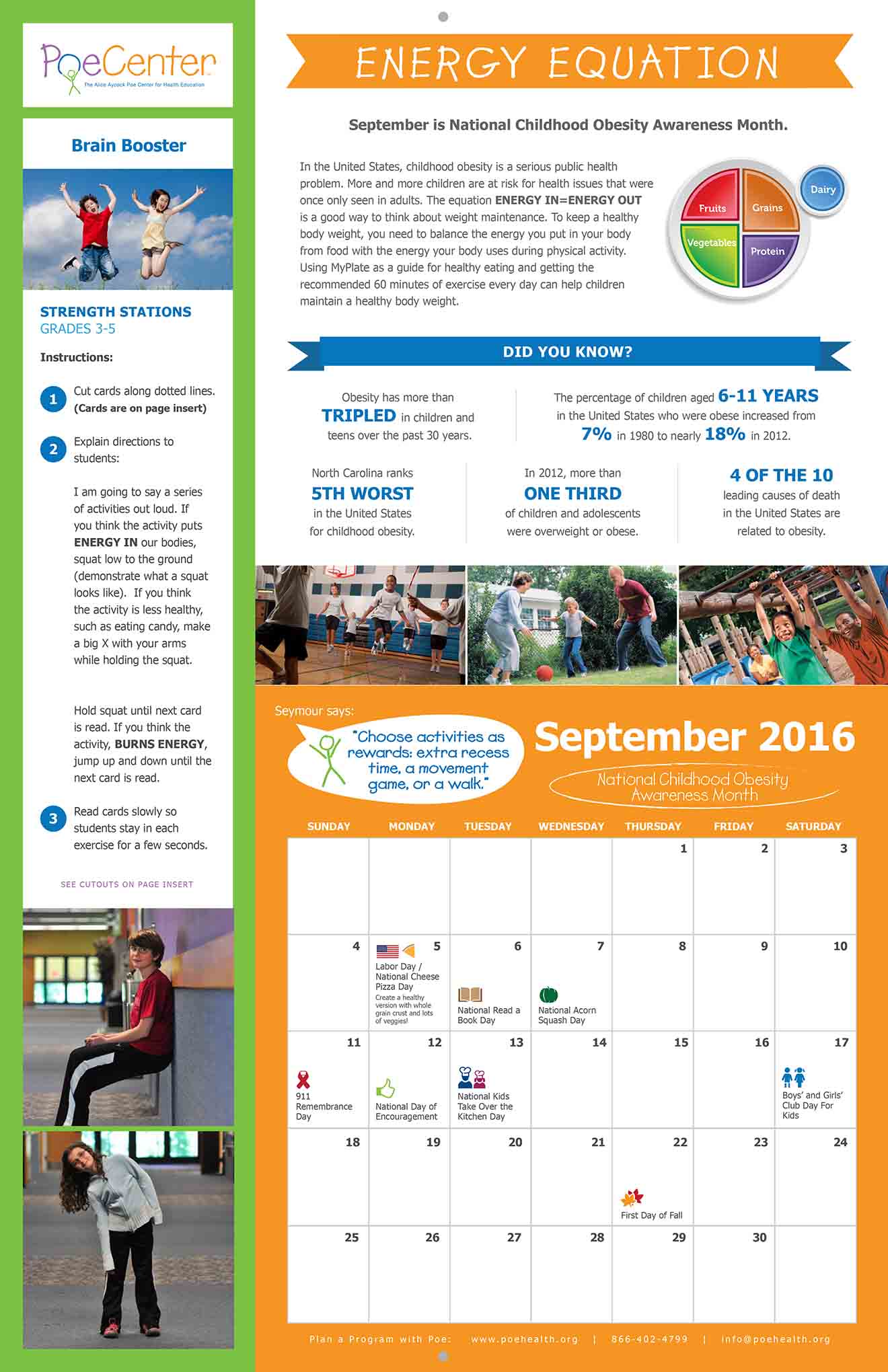
September is National Childhood Obesity Awareness Month.
In the United States, childhood obesity is a serious public health problem. More and more children are at risk for health issues that were once only seen in adults. The equation
ENERGY IN= ENERGY OUT is a good way to think about weight maintenance. To keep a healthy body weight, you need to balance the energy you put in your body from food with the energy your body uses during physical activity. Using MyPlate as a guide for healthy eating and getting the recommended 60 minutes of exercise every day can help children maintain a healthy body weight.
DID YOU KNOW?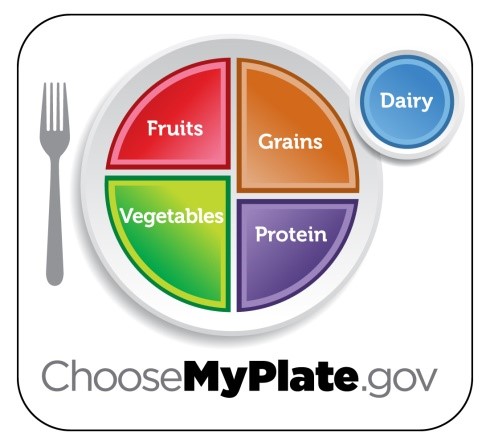
- Obesity has more than TRIPLED in children and teens over the past 30 years.
- The percentage of children aged 6-11 YEARS in the United States who were obese increased from 7% in 1980 to nearly 18% in 2012.
- NC 5TH WORST in the United States for childhood obesity.
- In 2012, more than ONE THIRD of children and adolescents were overweight or obese.
- 4 OF THE 10 leading causes of death in the United States are related to obesity.
Try this BRAIN BOOSTER to build some physical activity into the classroom.
STRENGTH STATIONS
Grades 3 -5
Instructions:
- Download and print Strength Station Cutouts.
- Cut cards along dotted lines.
- Explain directions to students:
I am going to say a series of activities out loud. If you think the activity puts ENERGY IN our bodies, squat low to the ground ( demonstrate what a squat looks like) .
If you think the activity is less healthy, such as eating candy, make a big X with your arms while holding the squat. Hold squat until next card is read.
If you think the activity, BURNS ENERGY, jump up and down until the next card is read.
- Read cards slowly so students stay in each exercise for a few seconds.
Find this activity and many others in Poe's Nutrition & Physical Activity Classroom Calendar. Download it for FREE.
References/Resources:
- American Public Health Association. (n.d.). Public health takes on obesity: A route to better health [Infographic]. Retrieved from http://action.apha.org/site/PageServer?pagename=Obesity_Infographic
- Centers for Disease Control and Prevention. (2015, August 27). Childhood Obesity Facts. Retrieved from http://www.cdc.gov/healthyschools/obesity/facts.htm
- East Smart, Move More NC. (2009). The Burden of Obesity in North Carolina (Adults, Children, and Youth). Retrieved from http://www.eatsmartmovemorenc.com/ObesityInNC/ObesityInNC.html
- Prevention Partners. (n.d.). 2015 NC Prevention Report Card. Retrieved from http://forprevention.org/p2/resources/2015-nc-prevention-report-card/
This material was funded by USDA’s Supplemental Nutrition Assistance Program. The Supplemental Nutrition Assistance Program provides nutrition assistance to people with low income. It can help you buy nutritious foods for a better diet. To find out more, call 1-800-221-5689. In accordance with Federal law and U.S. Department of Agriculture policy, this institution is prohibited from discriminating on the basis or race, color, national origin, sex, age, religion, political beliefs or disability. To file a complaint of discrimination, write USDA, Director, Office of Civil Right, 1400 Independence Avenue, SW, Washington, DC 20250-9410 or call (800)795-3272 (voice) or (202)720-6382 (TTY). USDA is an equal opportunity provider and employer. The Poe Center is an equal opportunity provider and employer.
Op-Ed: Physical activity should be incorporated into the classroom daily
Op-Ed: Physical activity should be incorporated into the classroom daily
Sarah Heckler, MS, CISSN- Dietetic Intern
September is National Childhood Obesity Awareness Month, which is a great opportunity to evaluate and improve current wellness policies in order to combat childhood obesity. There is no better place to start than schools. Schools are a major contributor to a child’s dietary and physical activity behaviors (Centers for Disease Control and Prevention [CDC], 2015). In fact, school-aged children spend more than half their waking hours and consume half their calories while at school. Therefore, teachers need to be given the time and resources to incorporate physical activity into the classroom beyond time spent in recess and PE.
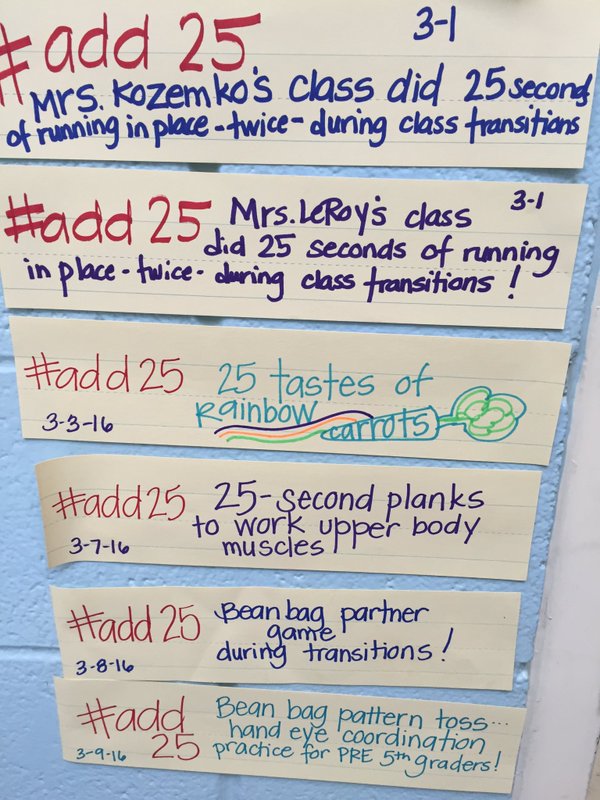
We are going to #add25 jumping jacks to our morning routine this week! @EastGarnerPE @PoeCenter pic.twitter.com/51cOwBpdf5
— Ms. Schenk (@ms_schenkEGES) March 7, 2016
One in three children, in our country, is overweight or obese, which can lead to an increased risk of type 2 diabetes, high blood pressure and heart disease (“September National Childhood Obesity Awareness Month,” 2016). According to the Alliance for a Healthier Generation, youth need at least 60 minutes of physical activity every day. Incorporating physical activity into the school day can help children meet that recommendation.
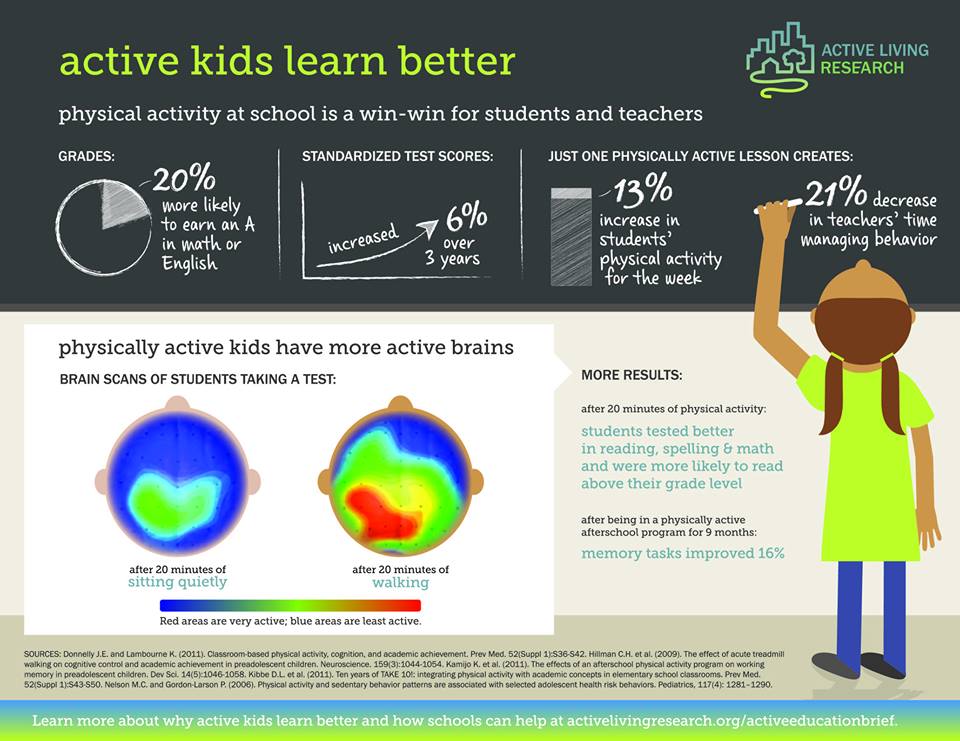
The benefits of being active throughout the school day extend well beyond physical health. According to Bangsbo and colleagues (2016) “Physical activity before, during and after school promotes scholastic performance in children and youth.” Furthermore, the time used for physical activity did not negatively impact time spent on scholastic performance. Additionally, physical activity can positively influence self-esteem, relationships, and other social and psychological outcomes. In fact, even one session of physical activity in the school day can have a positive impact on brain function, cognition and scholastic performance (The Active Living Research Organization demonstrated (Spoon, 2015):
- A more active brain, in children, after 20 minutes of walking. Additionally, reading, spelling, and math grades were improved, as well as a 16% improvement in memory tasks.
- Improvements in standardized test scores and math and English grades, a 6% and 20% increase respectively
- One lesson with physical activity increased the students’ physical activity for the week by 13%.
- A decrease in teachers’ time of managing behavior issues.
There are a variety of resources available to help teachers and educators easily build physical activity into their lesson plans and school day. Action for Healthy Kids provides activities teachers may use to engage students, no matter where they are, including the playground, the cafeteria, the classroom, and many more. The Poe Center’s Nutrition & Physical Activity Classroom Calendar is a free tool which features a monthly health topic along with easy-to-use classroom activities, including snacktivities, brain boosters, and links to additional resources.
It is easier to establish healthy behaviors at a younger age than to try and change unhealthy ones years later (CDC, 2015). Therefore, it is our responsibility to create a school environment that supports positive health behaviors so healthy children become healthy adults.
References:
Active Learning Opportunities - Action for Healthy Kids. Retrieved September 01, 2016, from
Bangsbo, J., Krustrup, P., Duda, J., Hillman, C., Andersen, L., Weiss, M., …Elbe, A. (2016, May 10). The Copenhagen Consensus Conference 2016: children, youth, and physical activity in schools and during leisure time. British Journal of Sports Medicine, 1-2. doi: 10.1136/bjsports-2016-096325.
Move More and Increase Your Family's Physical Activity. (n.d.). Retrieved August 30, 2016.
September National Childhood Obesity Awareness Month. (n.d.). Retrieved August 30, 2016.
Spoon, C. (2015, January 28). Active Living Research. Retrieved September 01, 2016.
Whole School, Whole Community, Whole Child. (2015). Retrieved August 30, 2016.
Painting the Past, Present and Future of Health Education
Painting the Past, Present and Future of Health Education
Kionna Coleman – Consultant and Freelance Writer, Poe Center Board of Directors
Inside a backyard art studio, North Carolina artist Nicholas Bragg was entertaining a small group gathered around him. “Do you know why the citizens of this state are called 'Tar Heels’?” he quizzed. No one knew the answer.
“The first exports from North Carolina were tar pits and turpentine,” he revealed. “Explorers came here looking for gold. It wasn’t here, but pine forest was.”
The thrill of exploration is in finding the unexpected. And the unexpected was what the Poe Center staff and board of directors encountered when several of them traveled to Winston-Salem in August to visit Bragg at his home.
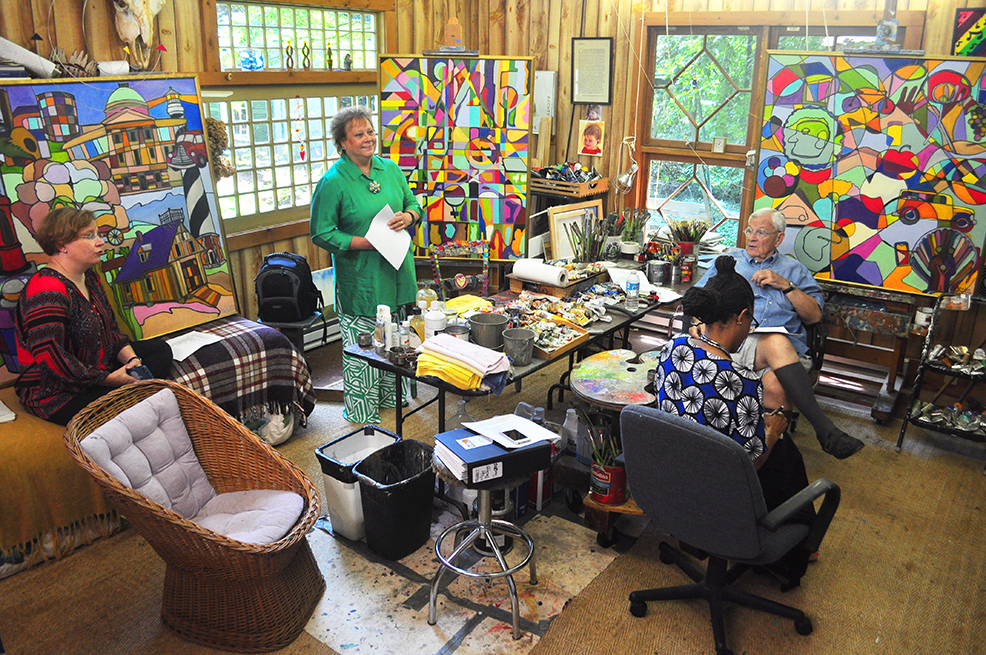
In February, Bragg generously donated his talent and agreed to create a mural in honor of the Poe Center’s 25th anniversary. Six months later, he invited us to his studio for a first-look at the finished masterpiece.
A charming man with a warm soul, Bragg welcomed us into his home that was, not surprisingly, filled with art. Each room was a mini-art museum of works by him, relatives, friends, and other artists he admires.
After chatting over coffee, we feasted on a delicious lunch. The dining room was brimming with sunlight and laughter as Bragg delighted us with stories of his childhood, life as a father of four, and his journey as an artist. We finished the meal with slices of fruit-topped cake, but the real dessert we craved was waiting for us in Bragg’s backyard.
The Big Reveal
The smell of turpentine hit us as we stepped into the large studio. But it was the massive panel against the front wall that instantly took our breaths away.
The mural, entitled "Alice Aycock Poe Center Twenty-Five Years and the World," measures 12x5 feet and is an extraordinary sight of color and imagery. Bragg created an artistic treasure, gracefully weaving Poe's past, present, and future within the context of world history. There are over 60 symbols embedded in the painting, including a touching tribute to his wife, daughter, and mother.
Bragg began the creative process in February, painting three maquettes to experiment with ideas, technique, and color. He didn’t like the first version, so he painted over it. Then he had an idea. “I penciled around that basket and created the North Carolina state seal,” he said, pointing to a jagged-edge basket on a high shelf. “I don’t try to be photo-real in anything; I find that very boring. I went from there, and I kept drawing."
Susan Bragg Foster, a health educator at the Poe Center and Bragg's daughter, was the key link between Bragg and the Poe Center helping to coordinate conversations with Poe staff, board members, donors and the Poe family ensuring that the mural was a true reflection of the people of Poe.
The eighty-year-old artist has created over 700 paintings in his lifetime. The Poe Center mural is Bragg’s seventeenth in the 15 years he retired as the executive director of Reynolda House Museum of American Art.
Despite his extensive experience and obvious talent, Bragg has an endearing humility about his artwork. “I’m not a great artist,” he said emphatically. We disagree.
Through "Alice Aycock Poe Center Twenty-Five Years and the World," Bragg has beautifully captured the Poe Center’s mission and its impact on the lives of over a million youth in North Carolina through health education. And we are excited to show the world the artistic gold he has bestowed us.
The Poe Center will unveil the mural during our 25th Anniversary Celebration Gala on September 24, 2016. Located just inside the front doors of the Poe Center, the mural will welcome all future visitors to Poe. School children, parents, and guests will be able to interact with the art that is a lesson in health.
Join us to celebrate 25 years of the Poe Center and the reveal of "Alice Aycock Poe Center Twenty-Five Years and the World" by Nicholas Bragg during our Celebration Gala on September 24, 2016, from 7:00 pm-10:00 pm. Purchase your tickets today.
See more photos of our visit with Mr. Bragg on Poe's Facebook page.
Knowledge is Power: Talk with your kids about their bodies.
Knowledge is Power: Talk with your kids about their bodies.
Robin Pittman MS, CHES - Senior Health Educator
In 1990, there were an estimated one million pregnancies and 521,626 births to U.S. women aged 15-19 years. Specifically in North Carolina, the teen birth rate was nearly 26 births per 1,000 teen girls. Since the 1990’s, teen pregnancy has declined 69%. Teen pregnancy is still a problem, but now it is the lowest it has been in the past few decades.
The Pew Research Center says the reasons for this decline are the poor economy, less teens having sex, better use of contraception and more information given to adolescents about how to prevent pregnancies.
Additionally, parents are talking more with their teens about this topic. Knowledge is power to youth. By educating children about these topics, teens can make educated and informed decisions, which can reduce sexual activity and pregnancy during the adolescent years.
Here are a few strategies to effectively talk with your child about sex and related issues.
- Give kids the facts. When teens have more information, they are more likely to make educated decisions about having sex. As a parent, you should be your child's go to person.
- Answer their questions. A one-time talk about the "birds and the bees" isn’t enough. Parents need to have ongoing conversations with their children about their bodies and sex. If your child asks you a related question, chances are he/she has already gathered information from somewhere else and likely needs correct or additional details. By responding to questions, you ensure your child gets good information, and you reduce the risk of him/her seeking help from unreliable sources, such as friends. Be ready for any question to come your way and take advantage of the teachable moment. It is okay to say, "let me think about it and come back with an answer for you." Just keep the conversation going.
- Set expectations and make your family values known. Explain your values and expectations to your children. Make it clear that you expect them to live up to those expectations. Be sure to set limits, including dating limits. Decide in advance what age you would like for your child to be before he or she starts dating or even holding hands with significant others. Make sure that everybody is on the same page. Every family is different. There are no set guidelines. Communicate early and consistently.
- Help kids to see the world beyond school and friends. Help your children to find his/her own passions and interests. For example, music, art, sports, theater, or community service are great outlets for adolescents. Help your children to think about their goals for the next five to ten years. Giving children a sense of purpose increases their self-esteem which in turn increases chances of delaying sexual activity.
- Find good resources. Books, such as “It’s So Amazing," “The Ultimate Girls Body Book," "The Ultimate Boys Body Book,” can help parents and their kids have open conversations and get good information about important adolescent issues.
The Poe Center is here to help. Our Family Life programs address adolescent development and related issues for 4th-12th grades. Additionally, we are offering our popular Girl Talk workshop for 4th-6th graders on September 10th from 9:00 a.m. - 11:00 a.m. To register, email Robin Pittman.
References
For the Classroom: Balancing Ball Activity
For the Classroom: Balancing Ball Activity
Robin Pittman MS, CHES - Senior Health Educator
Getting involved with sexual activity too early can increase stress for adolescents, who already are coping with the typical responsibilities and pressures of adolescence. This activity demonstrates how delaying sexual activity can reduce related stress, such as risks of pregnancy and sexually transmitted diseases. It also reinforces that abstinence is the only way to 100% prevent such issues.
Props needed:
- two beach balls
- permanent marker
Activity instructions:
In advance, write the following on each side (color) of one beach ball:
- participation in family activities and household chores,
- going to school,
- homework,
- hobbies/sports,
- friendships, and
- planning/preparing for the future.
Write the following on each side (color) of the second beach ball:
- disappointing one’s parents,
- plans for the future disrupted,
- contracting an STD,
- having trust broken,
- an unintended pregnancy, and
- stress and worry.
Ask six students to come to the center of the class and form a circle standing almost shoulder to shoulder. Then ask the students to take one step back. Show them the beach ball. Instruct them to keep the ball in the air using their hands, arms, shoulders, and head. Thank the volunteers and ask six more volunteers to also get in a circle.
Toss the second ball into the circle and intentionally try to cause the other ball to fall. This time ask the students to lock arms, so they can no longer use their hands.
After the balls fall, explain the challenges of being a teenager are great enough without the drama and confusion which are often associated with being in an intimate sexual relationship while a teenager.
Discuss that young people who choose abstinence instead of sexual risks have less stress in their lives and are better able to focus on other important things, such as family, schoolwork, and friendships.